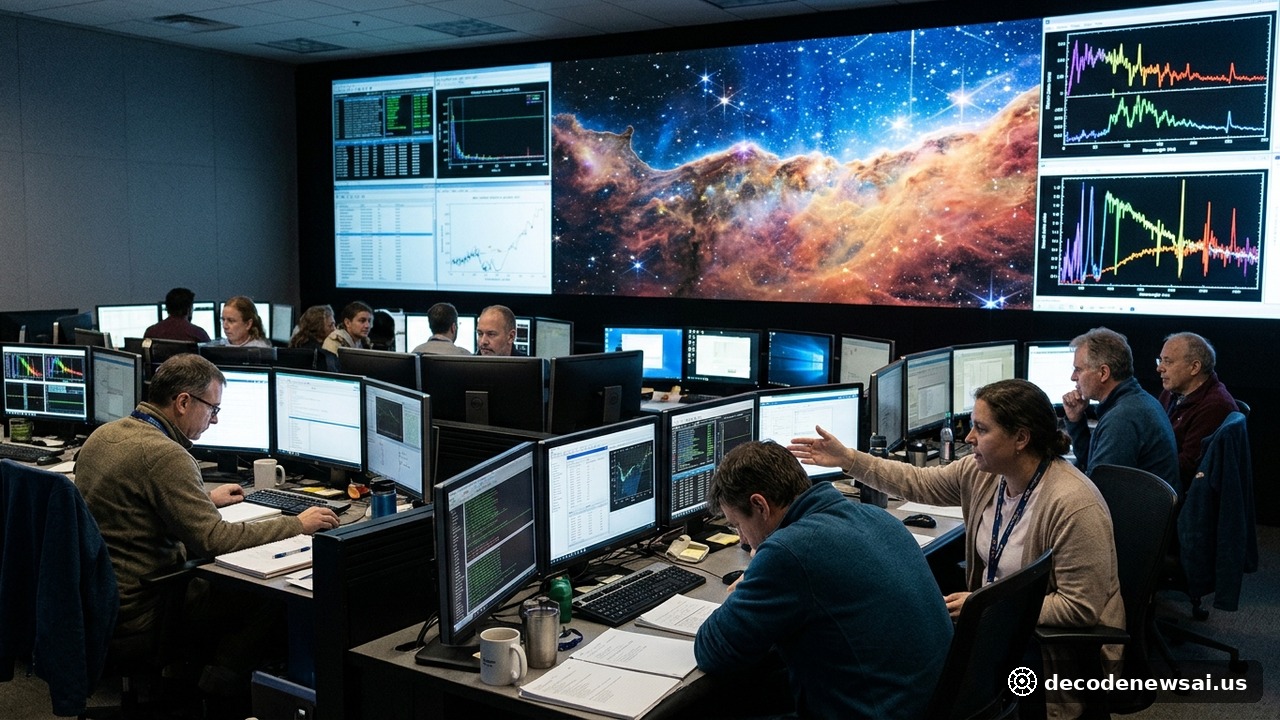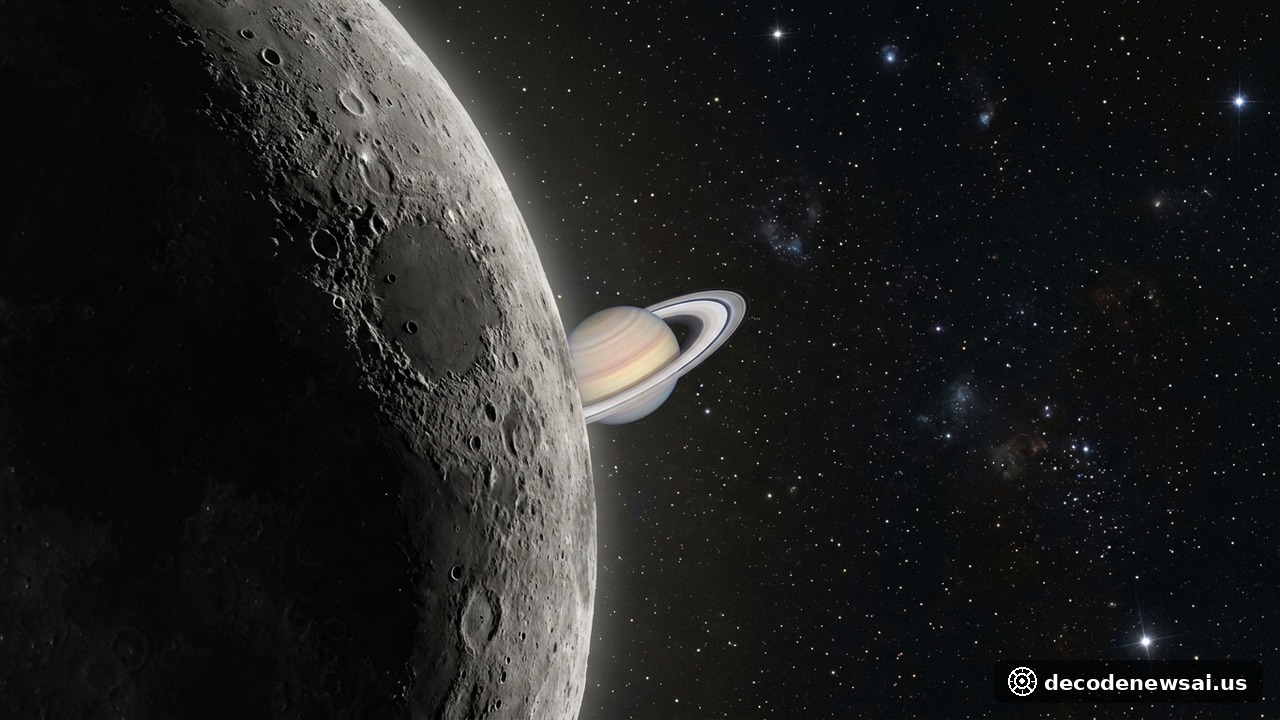
NASA's Science Mission Directorate featured a celestial event in its Astronomy Picture of the Day on November 10, 2026. The publication showcased Saturn Behind the Moon. The observation captures Saturn slipping behind the shadowed limb of the Moon. Space-based imaging from the James Webb Space Telescope was paired with high-altitude terrestrial observatories in South America. The geometry let planetary scientists harvest high-resolution spectroscopic profiles of Saturn's upper atmosphere and outer ring structures.
Atacama telescopes record sharp Saturn occultation light curves
Lunar occultations of major planets provide rare conditions for observational astronomers. From Earth's vantage, the Moon moves at roughly one kilometer per second. It eclipses distant background targets.
The composite photograph was captured with high-frame-rate optical cameras on giant telescopes across Chile's Atacama Desert. The composition pairs rugged lunar crater topography in the foreground with the luminous amber expanse of Saturn's disc. The Cassini division and high-latitude storm bands appear with striking clarity against the lunar surface.
The occultation sequence transpired over several dozen minutes. The Moon lacks an appreciable atmospheric envelope. Saturn's reflected sunlight extinguishes instantaneously at the lunar horizon. Astronomers obtained pristine light curves unobstructed by terrestrial atmospheric scintillation.
Webb spectrograph maps hydrocarbons in Saturn's stratosphere
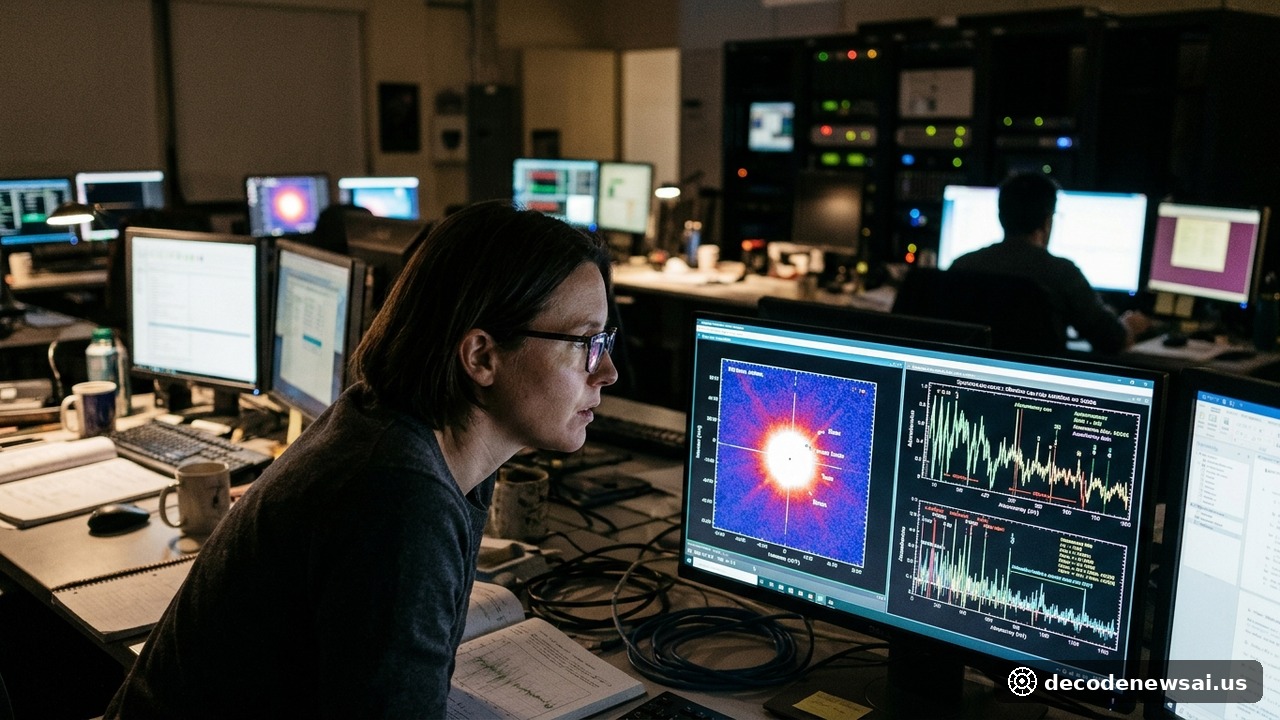
The lunar occultation gave astrophysicists a natural knife-edge aperture. The James Webb Space Telescope's Near-Infrared Spectrograph collected continuous spectra during the immersion phase.
Astrophysicists analyzed Fresnel diffraction patterns as the lunar limb clipped Saturn's translucent A-ring and F-ring boundaries. The data enabled precise vertical mapping of methane, ethane, and hydrocarbon aerosol concentrations across the Kronian stratosphere. The observations illustrate photochemical mechanisms catalyzed by solar ultraviolet radiation and auroral particle precipitation.
A senior planetary scientist spoke to science journalists at Goddard Space Flight Center in Greenbelt, Maryland. The scientist highlighted the research implications. The scientist stated: "The Moon's knife-edge limb functioned as a natural spatial occulting bar, allowing our teams to resolve particulate density variations across Saturn's outer rings at unprecedented spatial scales."
Occultation timings calibrate Saturn ring lifespan models
The multinational collaboration offers empirical validations for planetary ring lifespan models. Subtle variations in ring particle albedo corroborate theoretical estimates. Those estimates concern micrometeoroid bombardment erosion over geological epochs.
Astrophysical researchers and planetary science specialists noted that precise occultation timings provide calibration data. The data supports modeling of complex ring-satellite gravitational resonances across the Saturnian system. Ground-based telescopes and spaceborne observatories view lunar occultations from slightly offset vantage points. Coordinating simultaneous exposures enables stereoscopic reconstruction of ring optical depth variations at sub-kilometer physical resolutions.
Optical engineers emphasized that lunar limb diffraction measurements yield sharp structural profiles of Saturn's outermost ringlets. Conventional imaging cannot achieve this without dedicated interplanetary orbiter missions. The international astronomical community plans to synthesize these datasets. The work will refine numerical models of ring particle replenishment and orbital decay timescales ahead of future robotic exploration missions.
Calibrated spectral cubes enter public Planetary Data System archive
NASA confirmed that calibrated raw spectral cubes will be integrated directly into the public Planetary Data System archive. University research faculties worldwide can access the datasets without licensing restrictions. The observation underscores the continuing wonder of solar system celestial mechanics.
International planetary science institutes and university astrophysics departments affirmed that multi-observatory coordination advances solar system exploration. By integrating high-precision spectroscopic telemetry, planetary researchers continue to unlock insights into the evolutionary history of planetary rings.
Astronomical observatories worldwide highlighted that collaborative celestial monitoring enriches humanity's shared astrophysical knowledge base. Researchers emphasized that combining terrestrial and orbital telescopic assets remains an indispensable scientific strategy. That strategy unravels the intricate mechanics of planetary environments.