An international collaboration of condensed matter physicists announced an experimental milestone in quantum photonics on November 6, 2026. Detailed in a peer-reviewed publication titled 'Room-Temperature Quantum Emission from Boron Nitride Nanotubes' published across arXiv and the Journal of Applied Physics, researchers confirmed the observation and deterministic control of isolated spin color-center defects hosted within hollow, one-dimensional boron nitride nanotubes (BNNTs). The experimental achievement demonstrates coherent, narrow-linewidth single-photon emission under ambient atmospheric temperature and pressure conditions, bypassing the cryogenic cooling refrigeration historically required to suppress thermal phonon scattering across solid-state quantum optics.
Experimental Parameters and Physical Characterization of BNNT Quantum Emitter
- Host Material & Nanoscale Spatial Geometry: Boron Nitride Nanotubes (1D Hollow Nanotubes)
- Operational Thermal Window & Cryogenic Mandate: Ambient Room Temperature (No Liquid Helium Cooling);BioScience Journal Physical Sciences
- Spectral Emission Range & Linewidth Profile: Full Visible Spectrum Coverage; Stable Emission;Royal Society of Chemistry Materials Review
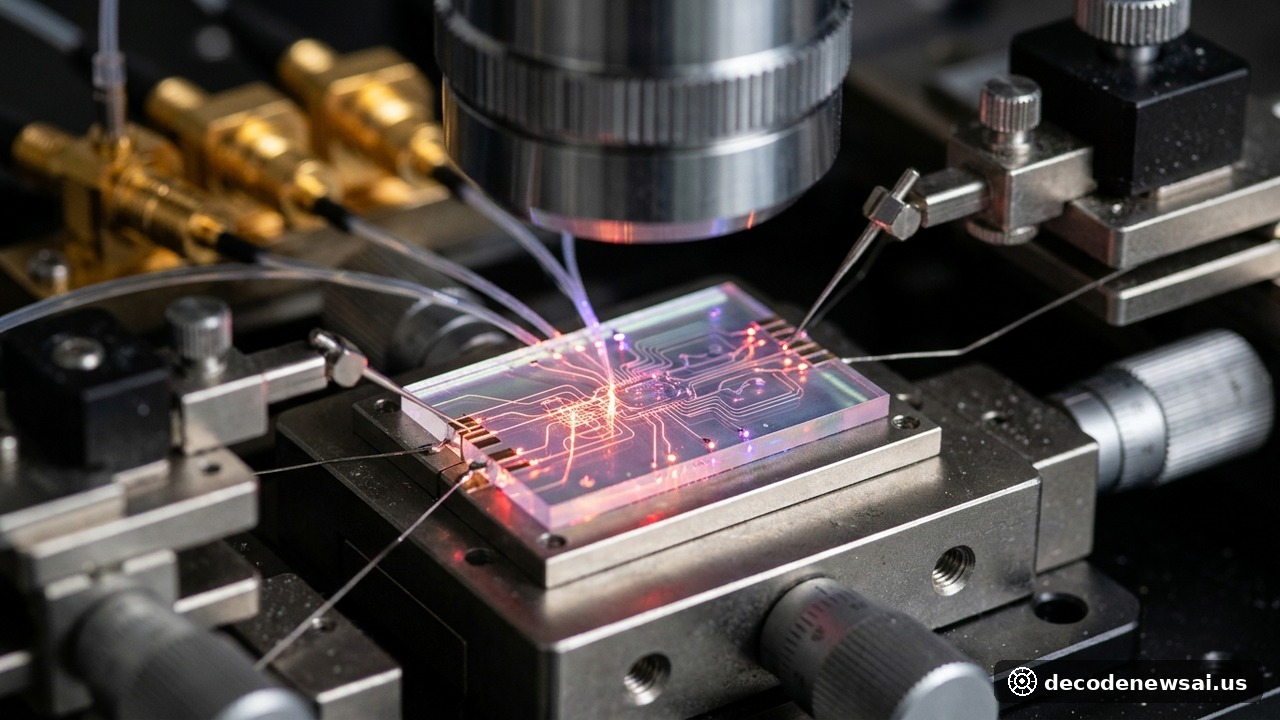
- Applied Technological Translation Vector: Quantum Key Distribution (QKD) & Photonic Chips;The Quant Advanced Technology Forum
Overcoming Thermal Phonon Noise to Achieve Room-Temperature Quantum Coherence
Single-photon emitters function as the indispensable operational foundation for unconditionally secure quantum cryptographic networks and photonic quantum processors.
Historically, solid-state quantum color centers—including diamond nitrogen-vacancy centers and gallium arsenide quantum dots—required operation within liquid helium cryostats at temperatures approaching absolute zero. When subjected to ambient room temperatures, intense thermal lattice vibrations induce severe phonon scattering, destroying electronic transition coherence and transforming single-photon emissions into uncorrelated classical electromagnetic noise. This thermal fragility historically confined quantum photonic hardware to specialized laboratory installations, precluding deployment inside compact satellite payloads, autonomous drones, or urban commercial telecommunications infrastructure. Isolating stable, optically addressable single-photon emitters within robust one-dimensional nanomaterials has represented an elusive objective for quantum optical engineering.
Wide Bandgap Isolation and Reduced Phonon Coupling in One-Dimensional Geometries
The research team overcame thermal dephasing by exploiting the wide electronic bandgap and low-dimensional confinement inherent to boron nitride nanotubes.
Catalyzing Practical Quantum Cryptography and Intracellular Quantum Biosensing
The demonstration of room-temperature quantum emission across boron nitride nanotubes alters development roadmaps across commercial quantum hardware sectors.
Applied physicists at leading quantum research consortia observe that ambient-condition single-photon emitters eliminate the severe size, weight, and power penalties associated with closed-cycle cryogenic compressors. Because BNNTs are naturally biocompatible and chemically inert, functionalized nanotubes can serve as nanoscale optical probes injected directly into living cells, utilizing coherent photons to map intracellular magnetic flux gradients and metabolic temperature variations with sub-micron precision. In commercial cybersecurity, integrating ambient-temperature single-photon sources directly onto silicon photonic circuits promises to reduce the volume and deployment cost of metropolitan quantum key distribution transmitters by orders of magnitude, accelerating the realization of decentralized global quantum networks and secure telecommunication backbones across commercial enterprise infrastructure.