The International Industrial Automation Consortium officially released unified architectural guidelines for Physical Artificial Intelligence systems on Sunday, establishing operational standards for autonomous robotic platforms deployed across high-precision manufacturing. Industrial deployment metrics published alongside the framework reveal operational productivity gains ranging between 20 percent and 30 percent across early manufacturing facilities. The release formalizes the transition of machine learning from digital analytic software into physical, sensor-integrated robotics capable of dynamic real-time reasoning within heavy industrial environments.
Framework integrates multimodal perception and closed-loop control
Unified Operational Framework Integrates Multimodal Perception and Closed-Loop Control
The engineering architecture was formally presented on November 8, 2026, during the Advanced Manufacturing Systems Symposium in Detroit. The standardized framework overcomes legacy limitations inherent in fixed-path industrial robotics, which historically required rigid programmatic calibration and struggled with unexpected operational variations.
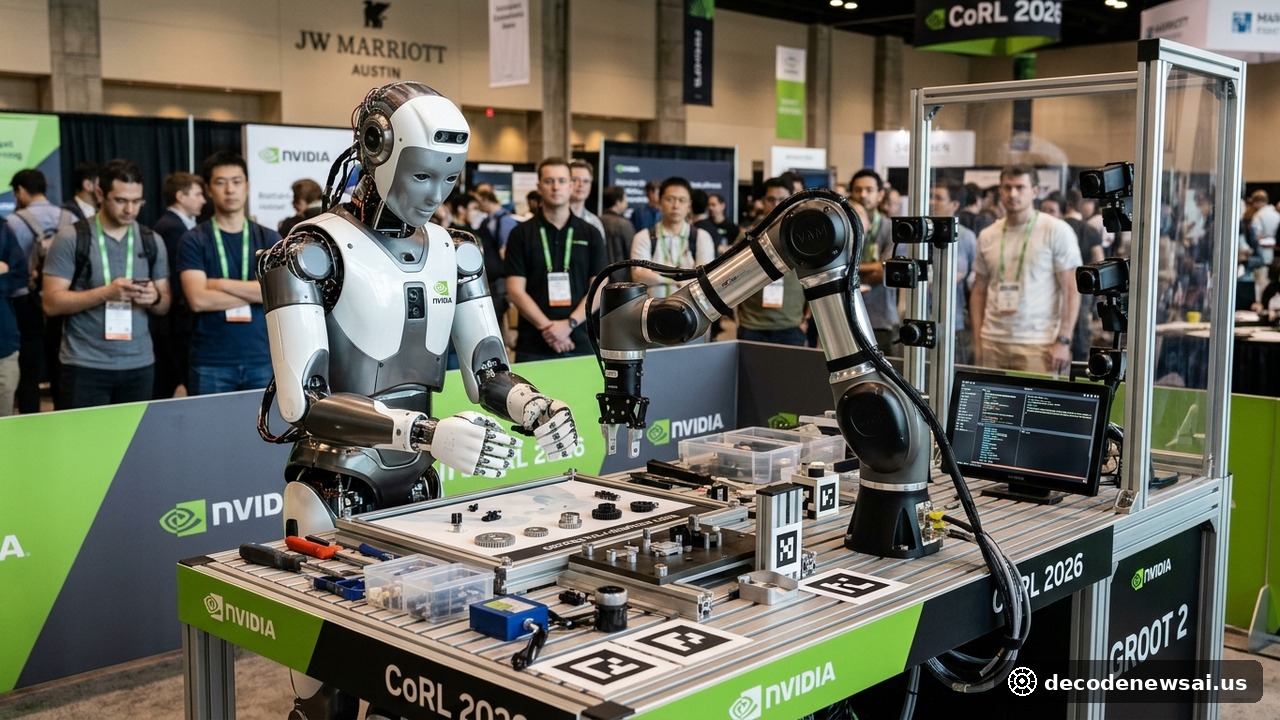
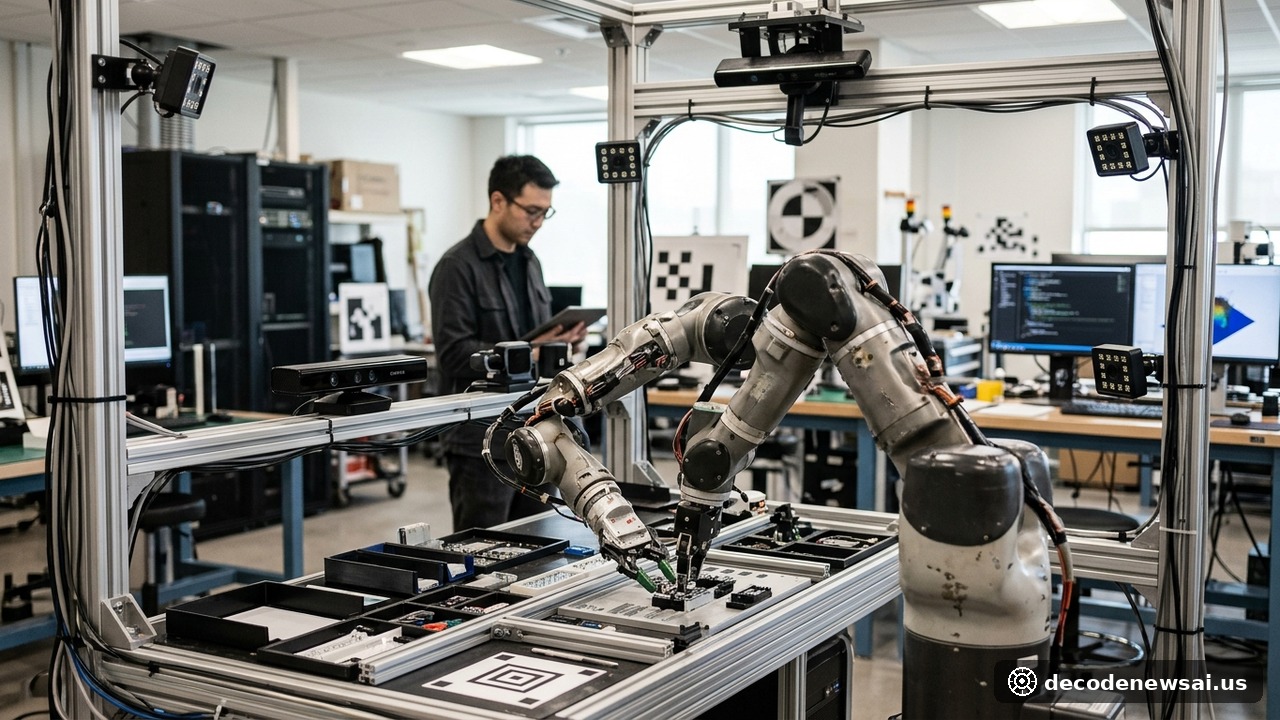
The framework integrates high-frequency sensor arrays directly with edge computational hardware, achieving sub-millisecond tactile and kinetic response loops. Demonstrations exhibited robotic manipulator arms successfully identifying, orienting, and assembling non-rigid, irregularly shaped mechanical components without prior manual geometric instruction. Spatial perception algorithms demonstrated reliable obstacle avoidance across shared assembly workspaces.
System compatibility represents a primary design objective. The physical AI protocols natively interface with existing enterprise Manufacturing Execution Systems (MES) and real-time digital twin environments, allowing plant operators to integrate robotic units modularly without requiring expensive, facility-wide production halts or structural assembly redesigns.
Automotive and heavy machinery sectors demonstrate scaled deployment
Automotive and Heavy Machinery Sectors Demonstrate Scaled Deployment
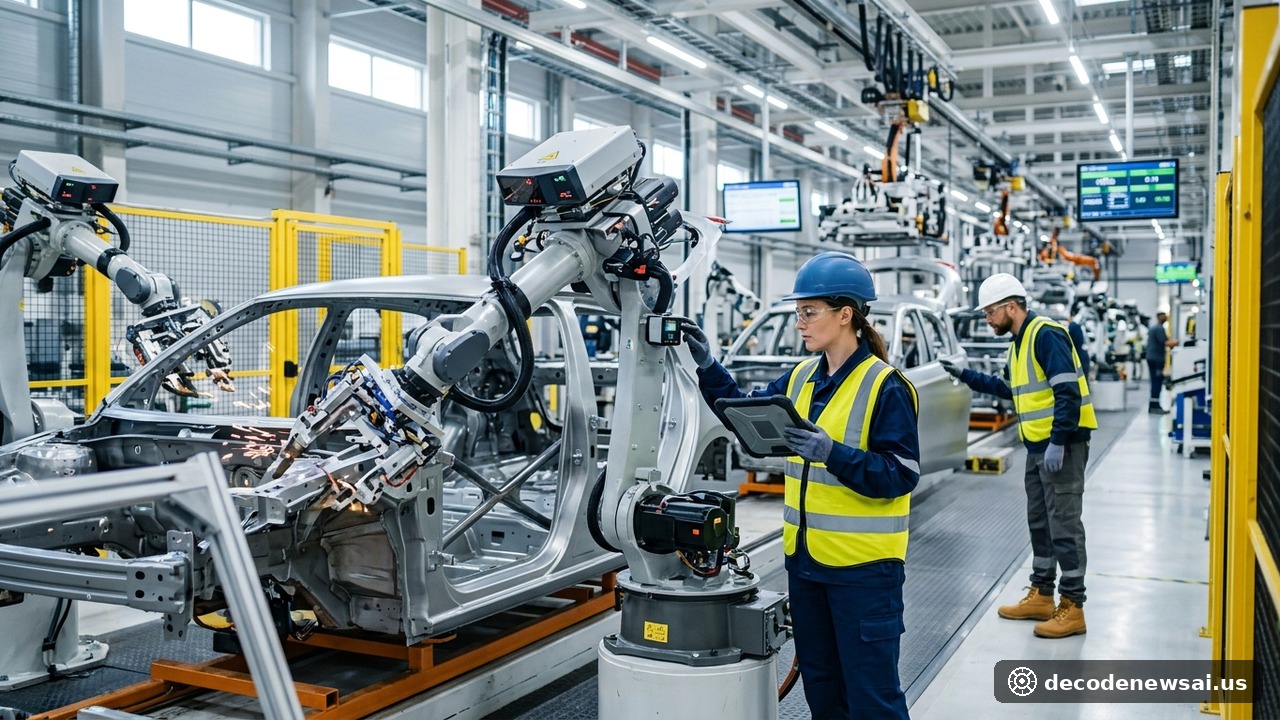
Automotive manufacturing assembly and heavy equipment production lines served as primary trial sites for the unified system architecture. Operational facilities operated by global automotive manufacturers observed inventory cycle-time reductions exceeding 25 percent within six months of initial station implementation.
High-mix, low-volume production facilities achieved notable productivity enhancements. In manufacturing lines that require frequent product switching, physical AI-equipped robotics eliminated protracted offline robotic programming by utilizing spatial depth mapping to autonomously generate manipulation trajectories. Transition intervals between different vehicle models decreased from days to minutes.
Engineering leadership underscored the technological inflection point represented by integrated physical learning. During a technical keynote address, David Miller, Director of the Advanced Manufacturing Systems Institute, stated, "Physical AI transitions robotics from repetitive execution mechanisms into cognitive operational partners capable of autonomous spatial problem-solving."
Functional safety standards and industrial hardware supply chains
Functional Safety Standards and Industrial Hardware Supply Chains
Elevated mechanical autonomy has prompted enhanced safety protocols governing human-robot collaborative workstations. The published guidelines mandate redundant hardware torque limiters, optical perimeter interlocks, and dynamic spatial buffers to prevent mechanical collisions with factory personnel. Safety compliance auditing represents an enforceable requirement for operational certification.
The expansion of physical robotic frameworks is accelerating demand across specialized component supply chains. Manufacturing demand has surged for energy-efficient on-device neural processing units (NPUs), solid-state lidar modules, and high-density brushless motor actuators. Component suppliers are scaling production lines to satisfy commercial deployment schedules.
Industrial standardization bodies across multiple nations are evaluating the consortium guidelines for integration into national engineering safety frameworks. The continued convergence of machine intelligence and physical automation marks a structural shift toward resilient, adaptive factory operations across global industrial sectors.
Analysts project embodied AI as manufacturing inflection point
Industrial robotics analysts project that the integration of embodied artificial intelligence into physical assembly operations marks a fundamental inflection point for modern manufacturing ecosystems. As sensor miniaturization and real-time inference continue to mature, automated production environments will achieve unprecedented adaptability, reducing downtime while safeguarding workforce well-being across diverse industrial settings.
Enterprise manufacturing leaders emphasize that scalable industrial adoption relies heavily on deterministic execution and robust communications protocols. By standardizing physical artificial intelligence frameworks, global technology providers ensure that modern industrial facilities maintain operational stability while dramatically improving productivity, operational resilience, and cost efficiency across highly competitive international supply chains.