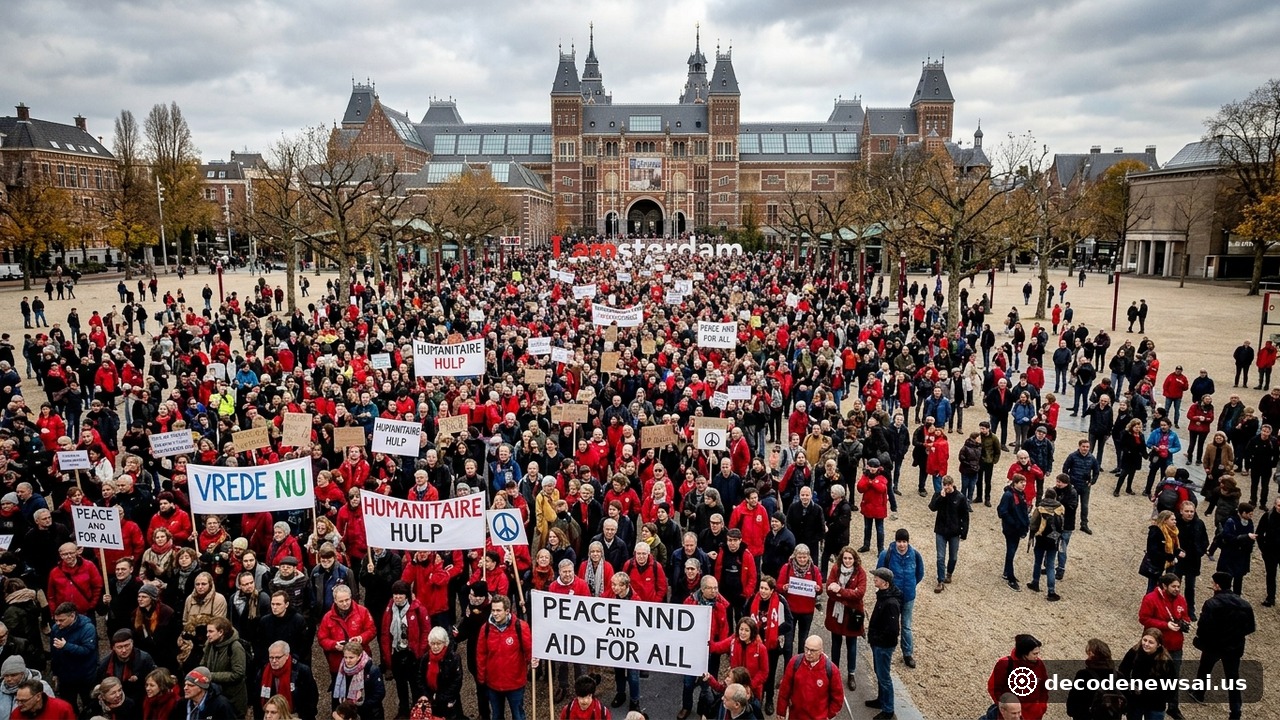
AMSTERDAM — More than 200,000 demonstrators dressed in red marched through central Amsterdam on Sunday, staging one of the largest rallies in recent Dutch history. The massive crowd filled Museumplein before streaming into surrounding boulevards. Protesters called on the Dutch government to halt military exports to Israel and enforce comprehensive trade sanctions. Broad Civil Society Coalition Organizes Fourth Red Line March The demonstration was organized by a broad coalition of human rights and humanitarian agencies. Over 130 organizations backed the rally. Core conveners included the Dutch branch of Amnesty International, Oxfam Novib, and Save the Children. Participants carried extensive banners demanding an immediate arms embargo and humanitarian protection across Gaza.
Fourth Red Line rally draws 250,000 before
The sheer volume of demonstrators halted vehicular traffic across major canal rings. Public transport faced severe diversions. Tram corridors were shuttered throughout the city center. Protesters formed symbolic lines across major thoroughfares to emphasize their message.
Organizers confirmed the gathering represents the fourth mass Red Line rally convened across the Netherlands. Public momentum continues to build. Previous mobilizations in The Hague and Amsterdam drew crowds of 100,000, 150,000, and 250,000 participants respectively over recent months. Jewish Protesters Join Call for Immediate Weapons Halt A diverse cross-section of residents and religious groups walked at the front of the procession. The gathering drew families, students, and union workers. Municipal authorities described the event as largely peaceful and disciplined, though local police detained four individuals following minor skirmishes.
Steven Eisinger, a Jewish demonstrator who joined the march, spoke candidly with news reporters along the route. Eisinger explained his decision to protest. Eisinger stated: "Stop sending weapons to Israel. I am Jewish myself, I have family in Israel, and it was important for me to say: I support Palestine and I am against genocide."
Dutch Cabinet Defends Diplomatic Efforts Amid Scrutiny
The display reflected widespread domestic unease with Dutch foreign policy. Anti-war sentiment ran high. Campaigners formally submitted petitions to members of parliament urging compliance with United Nations legal conventions and international humanitarian standards. Dutch Cabinet Defends Diplomatic Efforts Amid Intense Scrutiny The scale of the demonstration provoked immediate responses from senior government ministers. Political scrutiny is intensifying. Prime Minister Rob Jetten defended his administration's diplomatic record during his weekly press briefing in The Hague. While Jetten attended a previous Red Line march before taking office, he declined to participate on Sunday citing official neutrality.
Jetten maintained that Dutch diplomats are actively applying sustained bilateral pressure across all sides. Diplomatic engagement continues unabated. The prime minister pointed out that the Netherlands had enacted an import ban on goods produced in West Bank settlements and remains in dialogue with European partners.
Foreign Minister Tom Berendsen acknowledged the public outcry in a statement shared on social media. Berendsen reiterated the cabinet's formal support for Middle East de-escalation. The foreign minister stressed that achieving a viable two-state framework remains the only realistic path to long-term stability and regional security. Cross-Border Humanitarian Coalitions and Broader European Context The mobilization in Amsterdam mirrors a wider wave of civic pressure across Western Europe demanding foreign policy re-evaluations regarding Middle East conflicts. Grassroots campaigns continue to mobilize. Parallel solidarity rallies have taken place in Brussels, Stockholm, and Geneva, where international legal bodies and European Union institutions face sustained protests calling for the suspension of bilateral trade associations.
Humanitarian agencies press Dutch House of Representatives
Humanitarian agencies emphasize the ongoing distress across civilian population centers. International aid directors report severe supply chain bottlenecks for basic medicines and fuel supplies. By assembling hundreds of thousands of citizens in central Amsterdam, the organizers seek to build sustained parliamentary pressure ahead of upcoming budget and foreign policy debates in the Dutch House of Representatives.