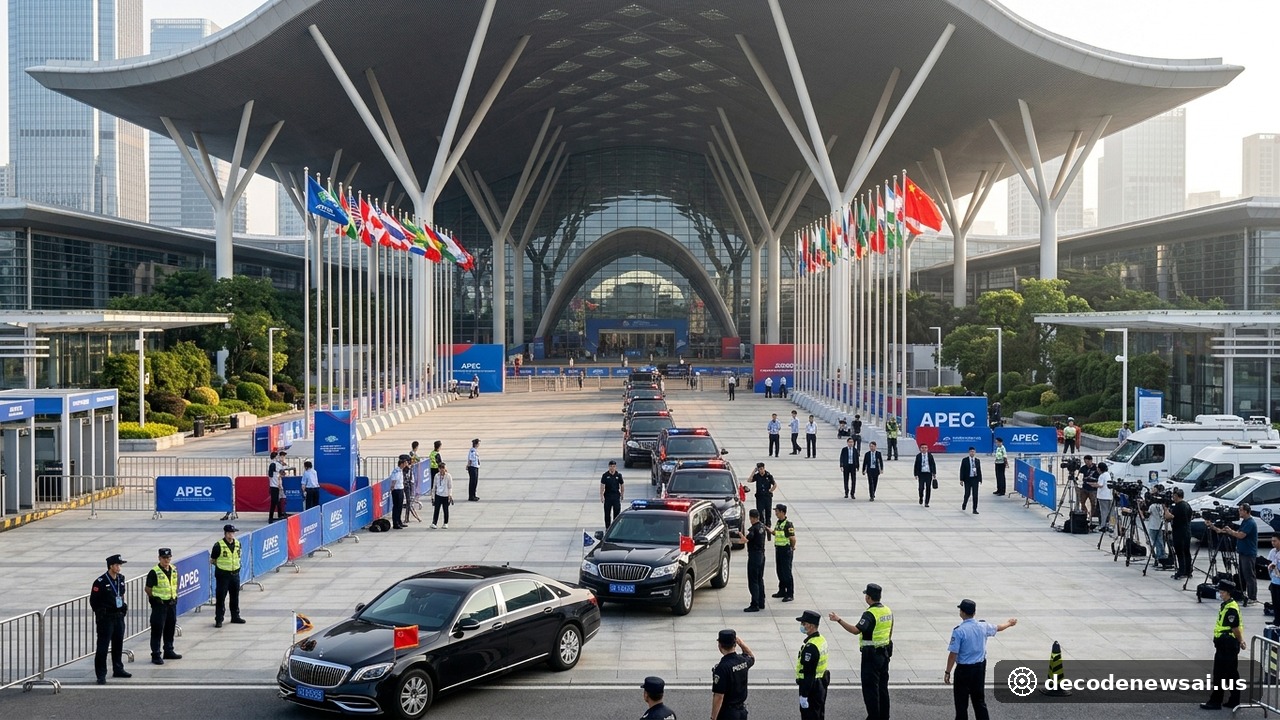
WASHINGTON - President Donald Trump confirmed on Monday, November 9, that he will travel to Shenzhen, China, to attend the 33rd Asia-Pacific Economic Cooperation Economic Leaders' Meeting scheduled for November 18 and 19. Speaking to reporters prior to his departure for Washington, Trump proposed holding an unprecedented trilateral meeting with Chinese President Xi Jinping and Russian President Vladimir Putin on the sidelines of the regional summit. The proposed high-level discussions aim to address strategic nuclear arms control, maritime de-escalation across Persian Gulf shipping lanes, and regional stability.
Shenzhen summit planning and diplomatic responses
The anticipated gathering in Guangdong province marks a significant diplomatic milestone in major-power engagement. President Trump stated directly during a televised press briefing: "I expect to meet with President Xi and President Putin in Shenzhen. We will discuss global denuclearization and resolving conflicts. When major leaders communicate, the entire world becomes safer." White House national security aides confirmed that advance planning teams have begun preliminary scheduling consultations with diplomatic counterparts in Beijing and Moscow to outline formal agendas.
Chinese foreign ministry officials responded in Beijing on Monday, indicating that China maintains ongoing communications with participating APEC delegations regarding bilateral and multilateral engagements. Emphasizing commitment to multilateral cooperation and economic integration across the Asia-Pacific region, Beijing underscored that summit diplomacy must adhere to principles of mutual respect and sovereign equality. Chinese diplomatic representatives noted that as host city, Shenzhen represents China's technological innovation and economic openness.
Russian diplomatic authorities in Moscow confirmed receipt of the American proposal for trilateral discussions. The Kremlin stated that direct high-level channels between nuclear powers remain essential to mitigate escalation risks, though formal protocols for the meeting remain under diplomatic review. European geopolitical observers noted that coordinating nuclear risk reduction while managing contested regional conflicts represents a historic test for global security governance.
Trade tariff suspensions and summit economic impact
The diplomatic initiative coincides with bilateral trade stabilization measures between Washington and Beijing. China announced on Monday that it has extended its suspension of a 24 percent reciprocal tariff on American exports by an additional two months, maintaining critical mineral export waivers through January 10, 2027. Concurrently, the United States Department of Commerce reaffirmed the temporary pause of its revised export control affiliates rule through the same date. Maintaining predictable regulatory frameworks allows multinational industrial corporations to preserve cross-border commercial ties during ongoing trade negotiations.
International political analysts emphasized that high-level summit diplomacy provides vital momentum for stabilizing global energy and commodity markets. Establishing structured communication channels between heads of state reduces miscalculation risks while ensuring transparency across commercial sea lanes and international supply chains. Delegations from across Asia-Pacific economies expressed hope that the Shenzhen summit will yield pragmatic frameworks for sustainable regional economic development.
Multilateral trade economists in Washington and Singapore observed that high-level diplomatic engagement at the APEC summit provides essential momentum for regional economic stability. Trade delegations representing twenty-one member economies will convene in Shenzhen to evaluate digital economy partnership agreements and clean energy infrastructure initiatives. Establishing predictable trade dispute consultation channels between the United States and China reassures global manufacturing supply chains. Geopolitical defense analysts highlighted that direct presidential communications substantially reduce maritime confrontation risks across Asia-Pacific shipping lanes. Coordinated summit agendas reflect a mutual commitment to preventing tactical frictions from escalating into broader economic disruptions across international capital markets.
Asia-Pacific leaders dialogue and market certainty
International economic advisors in Tokyo and Seoul observed that direct dialogue among Asia-Pacific leaders provides essential certainty for cross-border capital investment. Global trade federations noted that preserving stable maritime routes throughout the Pacific Basin safeguards energy transshipment corridors. Diplomatic delegations affirmed that collaborative summit frameworks help maintain regional momentum toward open, rules-based commercial partnerships across Asian markets.