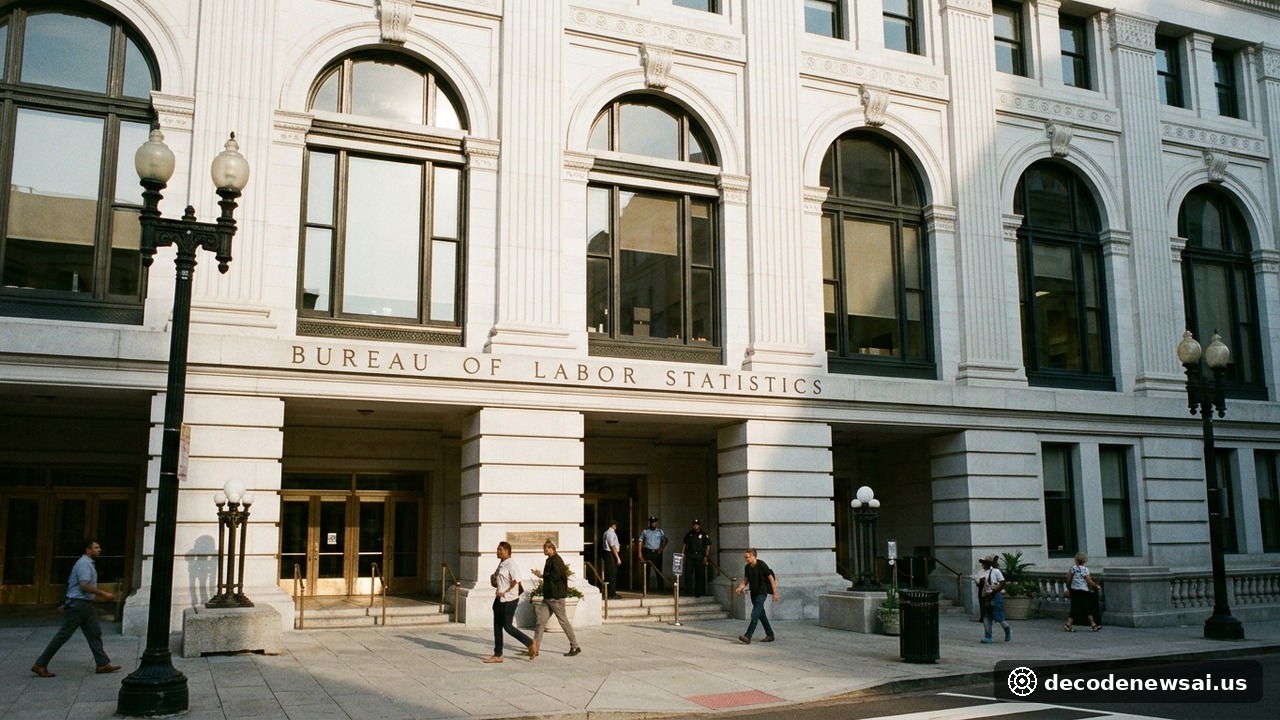
The United States Bureau of Labor Statistics (BLS) published crucial technical guidance on November 9, 2026, confirming that its upcoming October 2026 Consumer Price Index report will omit standard 12-month annual inflation calculations. Scheduled for release on Tuesday, November 10, the monthly report will forgo annual comparisons for both headline CPI and core CPI because data collection was completely halted during the federal government shutdown in October 2025. Financial markets and monetary policymakers will instead rely exclusively on month-over-month price changes to gauge inflationary pressures.
Wall Street shifts focus to monthly CPI changes
Under federal statistical integrity guidelines, government economists cannot fabricate or retroactively impute missing survey observations. In an official technical advisory addressing frequently asked questions, the agency confirmed that price collection personnel were prohibited from conducting field surveys or digital price gathering during the weeks the federal government remained shuttered. Consequently, any statistical series lacking valid October 2025 price samples cannot mathematically calculate a standard 12-month change.
The statistical anomaly presents market participants with an unprecedented evaluation challenge. For decades, the year-over-year percentage change has served as the universal headline figure utilized by the public, news organizations, and corporate planning committees to benchmark inflation trends.
With annual benchmarks absent, Wall Street economists are directing analytical focus toward monthly sequential changes. In September 2026, the headline Consumer Price Index advanced 0.6% on a seasonally adjusted month-over-month basis, primarily propelled by an acceleration in retail gasoline and energy costs. Core consumer prices, which exclude volatile food and energy components, increased 0.3% month-over-month, while shelter costs registered a 0.4% sequential gain.
Fed December rate decision hinges on CPI release
Consensus macroeconomic forecasts compiled by major institutional investment banks project that the October headline index will expand by approximately 0.3% sequentially. Core consumer inflation is forecast to rise by 0.2% month-over-month. If realized, the sequential deceleration would indicate that broad-based price pressures are beginning to stabilize.
The timing of the statistical release carries immense significance for the Federal Reserve. The Federal Open Market Committee (FOMC) will convene on December 8 and 9 for its final interest rate determination of 2026. At its previous meeting on October 28, the central bank voted 10 to 2 to hold the benchmark federal funds target range steady at 3.75% to 4.00%, with dissenting members pushing for an additional quarter-point tightening.
Subsequent labor market data, including the blockbuster October nonfarm payrolls report adding 165,000 jobs, elevated expectations of further monetary stringency. Pricing across CME FedWatch interest rate futures reflects an estimated 75% probability of a quarter-point rate hike in December.
BLS official defends month-over-month price metrics
During a technical press briefing in Washington, a senior BLS statistical officer emphasized adherence to empirical standards. The official stated: "The Bureau of Labor Statistics strictly adheres to verified sampling methodologies, providing market participants with transparent and objective month-over-month price metrics."
Asset managers and bond traders across international exchanges are positioning portfolios ahead of Tuesday's 8:30 a.m. Eastern release. Interpreting inflation through an exclusively sequential lens requires Wall Street to navigate monetary forecasting without traditional annual comparative baselines.
Monetary economists and macroeconomic forecasters emphasized that evaluating underlying price dynamics through sequential month-over-month trajectories provides actionable insight during transitional inflationary cycles. While standard 12-month annual benchmarks offer broad historical perspectives, high-frequency monthly indicators often detect turning points in consumer demand, wholesale energy costs, and service-sector pricing far more rapidly. Federal Reserve policymakers will closely analyze core services inflation, particularly shelter and transportation indices, to assess whether price stability is taking root across domestic retail markets. Financial market participants across fixed-income and equity exchanges are calibrating investment horizons around the central bank's upcoming December rate determination as incoming data reshapes monetary expectations. The Bureau of Labor Statistics confirmed that standard annual comparative methodologies will resume once historical baseline monthly records are fully established in future survey intervals.