An international astrophysical research team on Monday published findings on the arXiv preprint repository, reconstructing the orbital origin of a bolide that exploded above Massachusetts' Cape Cod Bay. By combining atmospheric plasma radar reflections with Doppler meteorological radars and infrasound arrays, scientists determined that the impacting object was an outer solar system "lone wolf." The space rock originated from the outer margins of the asteroid belt near Jupiter before entering Earth's atmosphere. Planetary defense tracking capabilities marked an important technical breakthrough.
Multi-Frequency Radar Telemetry Reconstructs Centimeter-Scale Trajectory
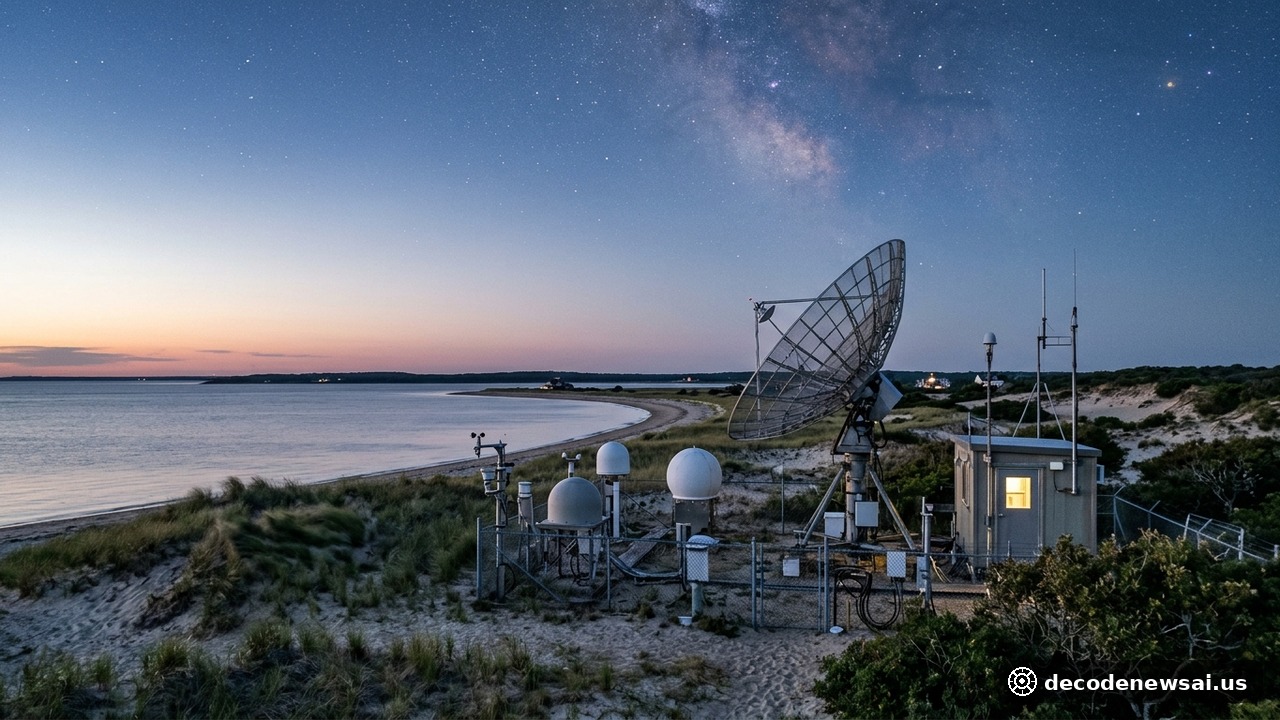
The space rock designated the Cape Cod Bolide produced a violent airburst upon entering Earth's dense upper atmosphere, scattering fragmented meteoritic debris across Cape Cod Bay. While optical tracking sensors were limited to instantaneous light curves, advanced radar stations operated by the Leibniz Institute of Atmospheric Physics and the SIMONe meteor radar network captured sustained reflections from head plasma and ionized trails. Radar instrumentation recorded continuous kinematic parameters. Trajectory reconstruction precision reached historic levels.
Researchers combined plasma echoes with high-resolution radar feeds from the National Weather Service's NEXRAD Doppler infrastructure. Ground stations successfully observed radar cross-section signatures from falling stones below cloud layers. Meanwhile, acoustic infrasound stations recorded low-frequency shockwaves generated by high-altitude atmospheric fragmentation. Fusing multiple telemetry streams eliminated orbital uncertainty. Inversion modeling produced unprecedented spatial accuracy.
Senior researchers presented technical findings during a press briefing on Monday morning. The lead author stated: "We cannot determine its exact initial history, but multi-frequency radar and acoustic data prove conclusively that this Cape Cod meteoroid traveled as a lone wolf near Jupiter's orbital zone before colliding with Earth." The research community commended the diagnostic methodology. Planetary detection systems demonstrated robust utility.
Outer Solar System Asteroid Populations and Planetary Defense Implications
Dynamical orbital integrations demonstrated that prior to gravitational perturbations by Jupiter, the meteoroid occupied an unstable resonance window in the outer asteroid belt. Unlike common near-Earth Apollo-class asteroids, the bolide displayed spectral indicators characteristic of primitive carbonaceous chondrites. The material preserves primordial volatile chemistry from the outer solar nebula. Scientific research value is exceptional.
The analytical framework presents immediate operational value for terrestrial planetary defense. The 2013 Chelyabinsk meteor airburst in Russia highlighted the risks posed by small asteroidal fragments that evade standard optical surveys. By deploying distributed meteor radar networks like SIMONe globally, defense systems can compute atmospheric impact trajectories and ground scatter footprints within seconds of upper-atmosphere entry. Warning response windows have expanded considerably.
Specialists from the International Meteor Organization commended the collaborative telemetry processing. Analysts noted that high-density radar installations advance scientific understanding while helping airspace warning systems differentiate between atmospheric bolides and human-made aerospace hazards. Scientific discoveries are translating directly into operational sensing tools.
Deep-Sea Specimen Recovery Operations and In-Situ Resource Insights
Orbital reconstruction of the Cape Cod bolide provides direct physical evidence regarding the dynamical evolution of outer asteroid populations. Research vessels are preparing autonomous underwater vehicles to conduct high-resolution sonar sweeps of the seafloor in Cape Cod Bay to locate fragmented meteoritic specimens. Recovered physical samples will undergo laboratory isotopic analysis to establish precise radiometric ages. Maritime recovery plans attracted widespread public fascination.
The discovery also offers vital mechanical data for future asteroid deflection architectures and space resource extraction programs. Establishing fragmentation thresholds and structural composition across diverse orbital populations is essential for designing kinetic impact planetary defense missions. Human planetary protection frameworks are evolving toward predictive precision. Space science capabilities continue to accelerate.
Astronomers shared the milestone preprint paper broadly across academic networks on Monday. Research institutions in Europe and South America are formulating deployment schedules for complementary atmospheric plasma radar arrays. Expanded global sensor coverage will reduce unmonitored blind spots across the upper atmosphere. Potentially hazardous near-Earth impactors will face continuous tracking. Scientific comprehension of the orbital environment has achieved an important new height.