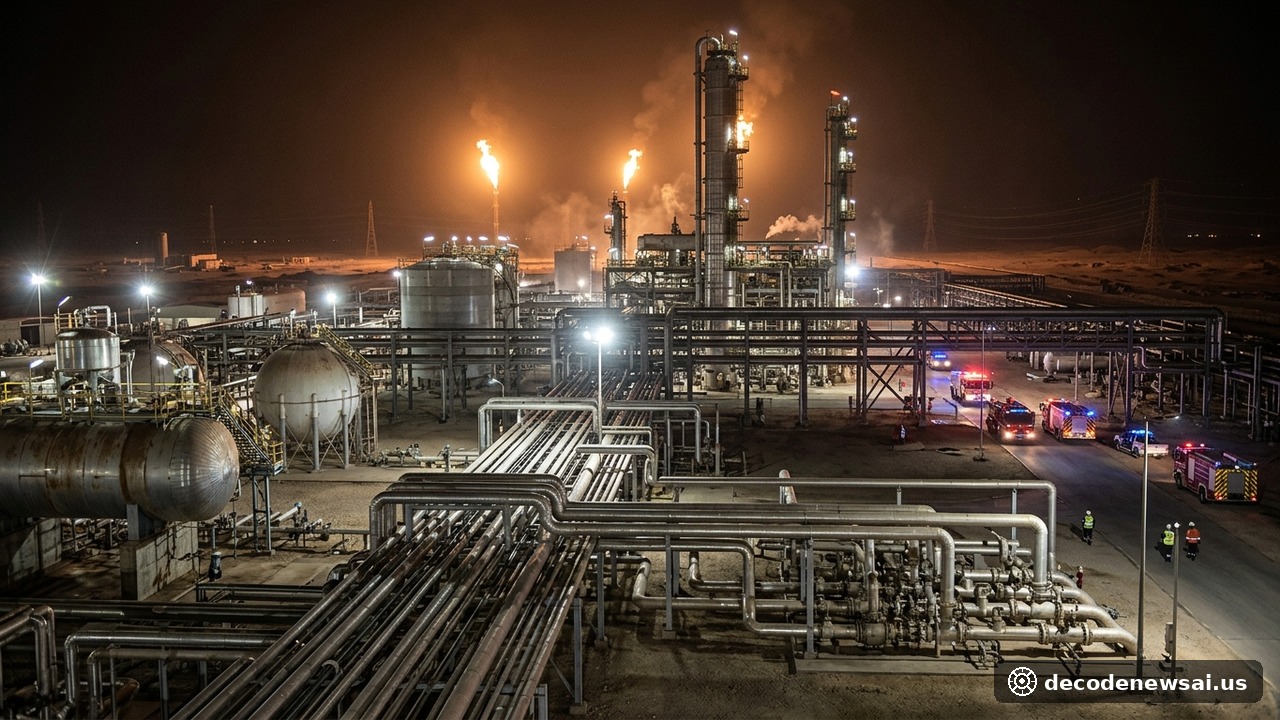
A suspected hostile drone strike hit the Khor Mor natural gas processing facility in Iraq's northern Kurdistan region on the night of November 8, 2026. The impact sparked a major localized fire at an essential liquid petroleum gas unit. Operational tracking logs confirmed that the attack occurred at approximately 11:10 p.m. local time. The assault forced an immediate suspension of all commercial natural gas operations across the installation. Because Khor Mor serves as the primary feedstock supplier for major regional power stations, the production outage caused an immediate energy shortfall across multiple provincial hubs.
Dana Gas confirms no injuries and 2,000 MW grid loss
The targeted energy complex is situated in the Qadir Karam subdistrict of Chamchamal within Sulaimani province. The field is operated under concession by United Arab Emirates-based energy developer Dana Gas PJSC. Initial security inspections revealed that a loitering drone munition struck fuel-handling gathering equipment, breaching pressurized transmission piping. Emergency response teams rushed to isolate fuel lines and contain spreading flames across adjacent utility corridors.
Onsite industrial firefighting squads worked alongside civil defense personnel to suppress the blaze within several hours. In an official corporate regulatory disclosure submitted from Sharjah to the Abu Dhabi Securities Exchange, Dana Gas confirmed that no company employees or contractors suffered injuries during the attack. Plant engineers initiated emergency shutdown protocols to isolate gas wells and minimize infrastructural destruction. Dedicated technical task forces are inspecting processing trains to gauge the exact structural damage to critical turbine units.
Khor Mor yields hundreds of millions of cubic feet of processed natural gas per day. Dedicated transmission pipelines connect directly to thermal generation utilities located in Erbil and Sulaimani. The sudden halt in dry gas delivery caused regional grid generation capacity to fall by more than 2,000 megawatts within minutes. Local electricity distribution directorates implemented rolling blackouts across metropolitan residential districts.
Iraqi PM Zaidi orders joint committee and air defenses
Iraqi Prime Minister Ali Faleh al-Zaidi, acting in his capacity as commander-in-chief of the armed forces, convened an emergency security council session in Baghdad. Prime Minister Zaidi ordered the immediate establishment of a joint high-level investigative committee comprising federal intelligence personnel and Kurdistan Regional Government liaisons. Zaidi condemned the attack on civil utilities. In a formal statement issued from Baghdad, Zaidi said: "Attacking vital national infrastructure constitutes direct sabotage against the Iraqi population, and those orchestrating these hostile operations will face full judicial accountability."
Kurdistan regional authorities urged federal defense ministries to deploy mobile air-defense detachments and radar surveillance platforms around the perimeter of the Khor Mor perimeter. State electrical grid operators redirected backup hydroelectric output from northern reservoirs to balance distribution baseloads. Standby mobile diesel generation units were mobilized to power central medical clinics and municipal water treatment plants. Regional leaders appealed for unified measures to secure the gas network.
The Khor Mor complex has repeatedly faced standoff drone and rocket strikes by regional armed factions seeking geopolitical leverage. These asymmetric attacks threaten broader international investor confidence in Middle Eastern upstream energy ventures. International observers noted that expanding energy corridors require multi-layered drone countermeasure suites. Dana Gas reiterated that commercial production will resume only after comprehensive technical clearances and joint security assurances are established.
Dana Gas sets repair protocols amid drone countermeasure calls
Federal operational commands deployed armed aerial reconnaissance patrols across uninhabited desert transit corridors between Kirkuk and Sulaimani. Forensic investigators recovered structural wreckage fragments to verify the launch trajectory. International partners reiterated commitments to Iraqi infrastructure stability.
Regional energy analysts and Middle Eastern security directors highlighted that recurring loitering munition assaults against civilian energy hubs pose severe structural hazards for regional power grids. Because natural gas processing infrastructure operates under intense operational pressures, unarmored gas gathering networks remain acutely vulnerable to hostile explosive detonation and prolonged outages. International energy consortiums and regional trade associations urged federal defense ministries to expand permanent air defense batteries and deploy drone countermeasure umbrellas around strategic production basins. Dana Gas established coordinated communication protocols with regional utility operators to accelerate technical repairs while guaranteeing structural integrity across all affected gathering lines. Diplomatic observers noted that stabilizing critical natural gas flows through northern pipelines remains essential for safeguarding civilian municipal electricity grids across Iraq.