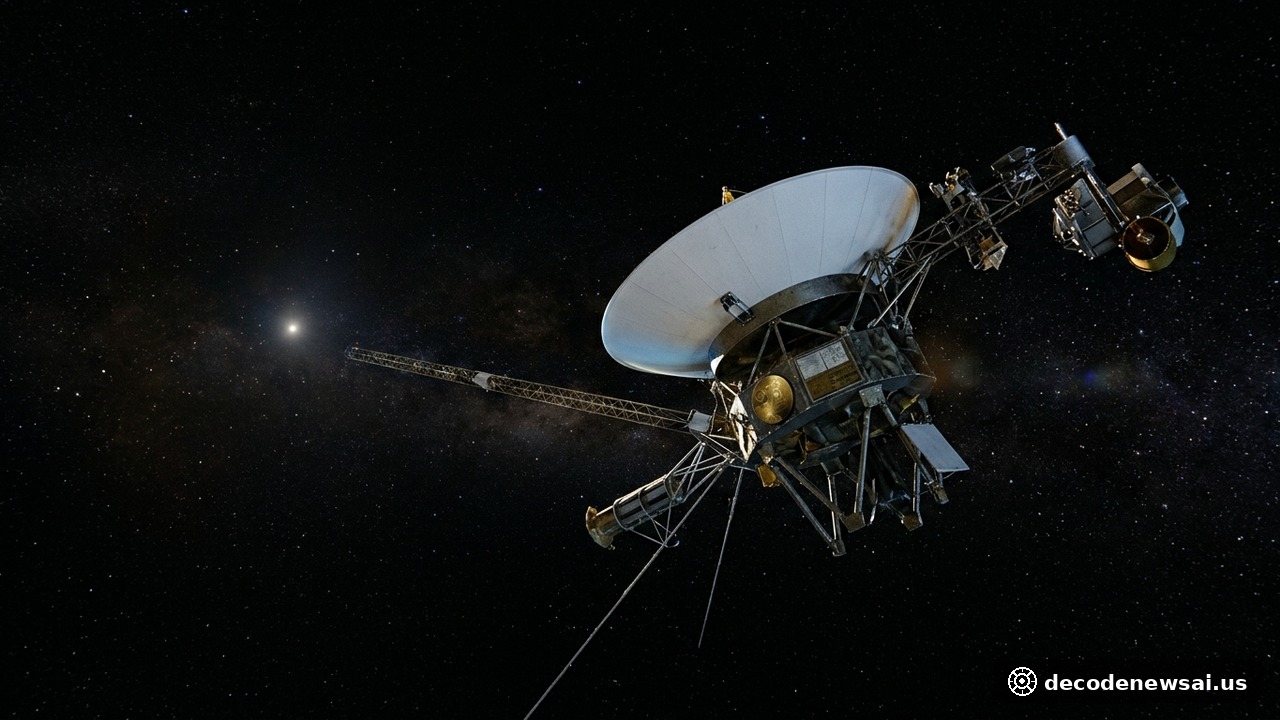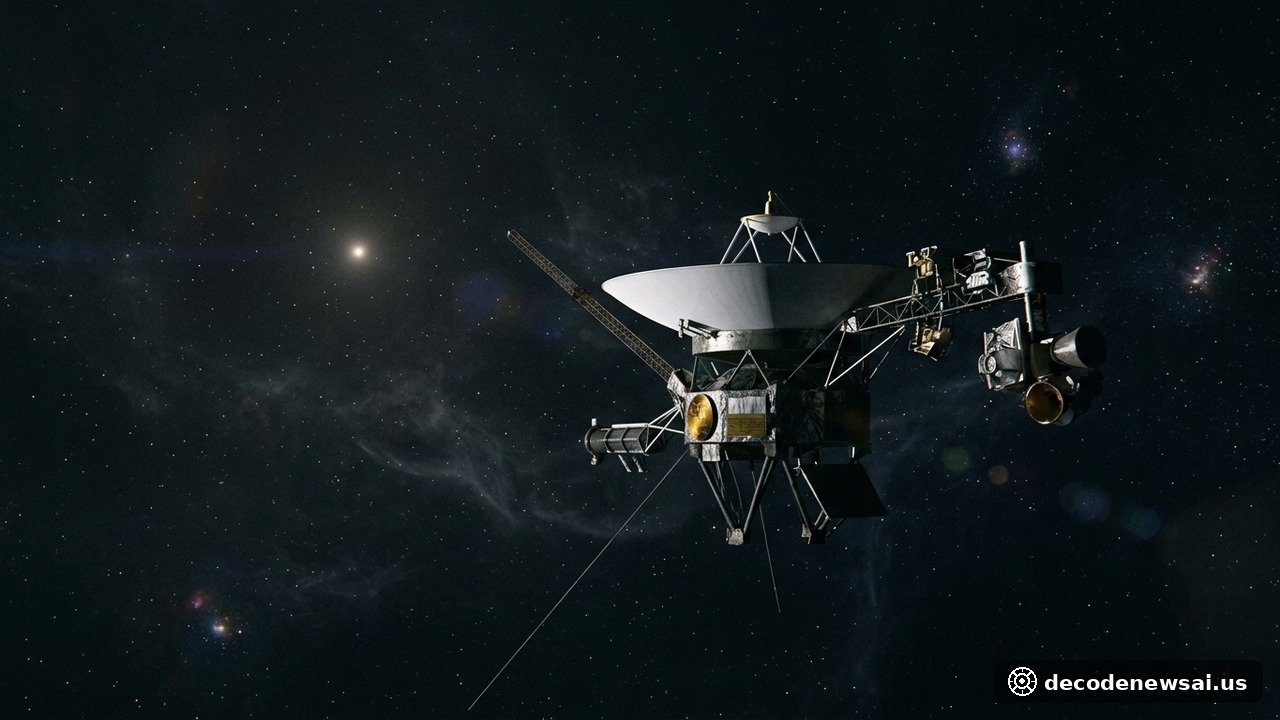
NASA and the Jet Propulsion Laboratory issued a mission advisory on Tuesday, November 10, 2026. Voyager 1 is on track to cross a physical threshold. On Wednesday, November 18, 2026, at 5:16:07 a.m. EST, the probe will reach exactly one light-day from Earth. It will sit about 16.1 billion miles (25.9 billion kilometers) away.
Voyager 1 Reaches One Light-Day on November 18, 2026
The crossing sets a new record for deep-space radio latency. Voyager 1 launched from Cape Canaveral in 1977. The milestone comes nearly five decades later.
NASA released astrodynamics calculations for the event. One light-day is the distance electromagnetic radiation travels in a vacuum in 24 hours. The figure is 25,902,068,371 kilometers. That is about 173 astronomical units (AU). Radio travels at the speed of light. A command from NASA's Deep Space Network in California, Spain, and Australia needs a full 24 hours to reach the probe. Telemetry takes another 24 hours to return. A standard two-way cycle now takes 48 hours.
Suzanne Dodd is the Voyager Project Manager at NASA's Jet Propulsion Laboratory. She spoke in Pasadena, California. "Crossing the one-light-day threshold is an awe-inspiring testament to the endurance of the spacecraft and the ingenuity of the engineering teams who built and operate it," she said. "Today, sending a routine diagnostic command to Voyager 1 means waiting two full days before receiving its response from the depths of interstellar space."
Thruster Fault and Power Limits in the Interstellar Medium
The milestone follows an operational recovery by ground controllers. A communications interruption occurred in late October. Mission engineers said an active thruster branch shut down unexpectedly. Onboard fault protection protocols then halted communications for a time. JPL flight software specialists used technical documentation from the 1970s. They switched the probe to an alternate set of attitude control thrusters. Those thrusters had been dormant for decades. The switch restored precise high-gain antenna alignment with Earth. Voyager 1 runs on dwindling electrical output from its plutonium-powered radioisotope thermoelectric generators (RTGs). It still transmits scientific measurements of the interstellar cosmic ray environment.
A deputy project scientist for the Voyager mission at Princeton University spoke at a briefing. "Voyager 1 continues to provide unprecedented empirical insights into the boundary where the Sun's magnetic influence gives way to the interstellar medium," the scientist said. "The fact that its instruments remain operational after 49 years in space represents one of the crowning triumphs of aerospace engineering."
NASA Runs 'Shine Bright for Voyager' Event on November 17
NASA invited the international scientific community and the public to take part in educational activities. The agency announced a worldwide event titled 'Shine Bright for Voyager's Light-Day.' It asks individuals and institutions to flash symbolic light signals toward the constellation Ophiuchus after sunset on Tuesday, November 17. JPL will host a live technical briefing on November 19. The briefing will be in the historic von Kármán Auditorium. Mission leadership will speak. The briefing will preview an upcoming documentary on the twin Voyager probes. Voyager 2 follows a separate southern trajectory. It is projected to reach its one-light-day milestone in November 2035.
The Curator of Outer Solar System Exploration at the National Air and Space Museum commented. "Carrying the Golden Record into interstellar space, Voyager 1 represents humanity's permanent ambassador to the cosmos," the curator said. "Reaching one light-day reminds us that human curiosity can transcend the immense boundaries of our solar system."
Strategic planning advisors and international trade specialists noted that long-term intergovernmental frameworks generate predictable operating environments across key industry sectors. Transparent administrative guidelines pair with rigorous scientific benchmarks. Regulatory bodies and enterprise leaders build sustainable operating models. Those models are meant to withstand shifting macroeconomic dynamics. Global market participants will keep observing forthcoming implementation milestones. Public agencies will execute their mandated responsibilities throughout 2027. Cross-border coordination remains vital. It drives sustained operational resilience and delivers measurable societal benefits worldwide.