The Federal Aviation Administration announced on Tuesday, November 10, 2026, that it has joined four other Cabinet departments in signing a comprehensive memorandum of understanding on counter-unmanned aircraft systems. The historic interagency pact establishes unified regulatory procedures for testing, deploying, and operating counter-drone defense technologies around sensitive federal facilities. The framework ensures that advanced airspace security measures can be implemented without compromising civil aviation navigation or passenger flight safety.
Five Federal Departments Establish Fast-Track Review Process for Counter-UAS Systems
The surge in commercial and hobbyist drone operations has heightened security risks surrounding airports, defense infrastructure, and national energy sites.
Under the operational protocols detailed in the interagency memorandum, the Department of Transportation, FAA, Department of War, Department of Homeland Security, Department of Energy, and Department of Justice will establish a standing joint technical assessment panel. The panel will conduct 30-day expedited safety reviews of proposed counter-drone deployments, including high-energy lasers, high-power microwave systems, and radiofrequency takeover devices. Review criteria require thorough validation that defensive countermeasures do not interfere with aircraft instrument landing systems, air traffic control radars, or emergency communications.
FAA Administrator Bryan Bedford stated in Washington: "Protecting critical national infrastructure against rogue drone threats is an urgent national priority, but we cannot afford to degrade the safety margins of our commercial aviation network. This interagency agreement creates a transparent, standardized review process ensuring that counter-drone capabilities are integrated safely alongside civil air traffic."
Standardizing Laser and Microwave Defenses with Real-Time Air Traffic Coordination
In addition to technology vetting, the agreement establishes clear operational command boundaries for federal law enforcement and military personnel.
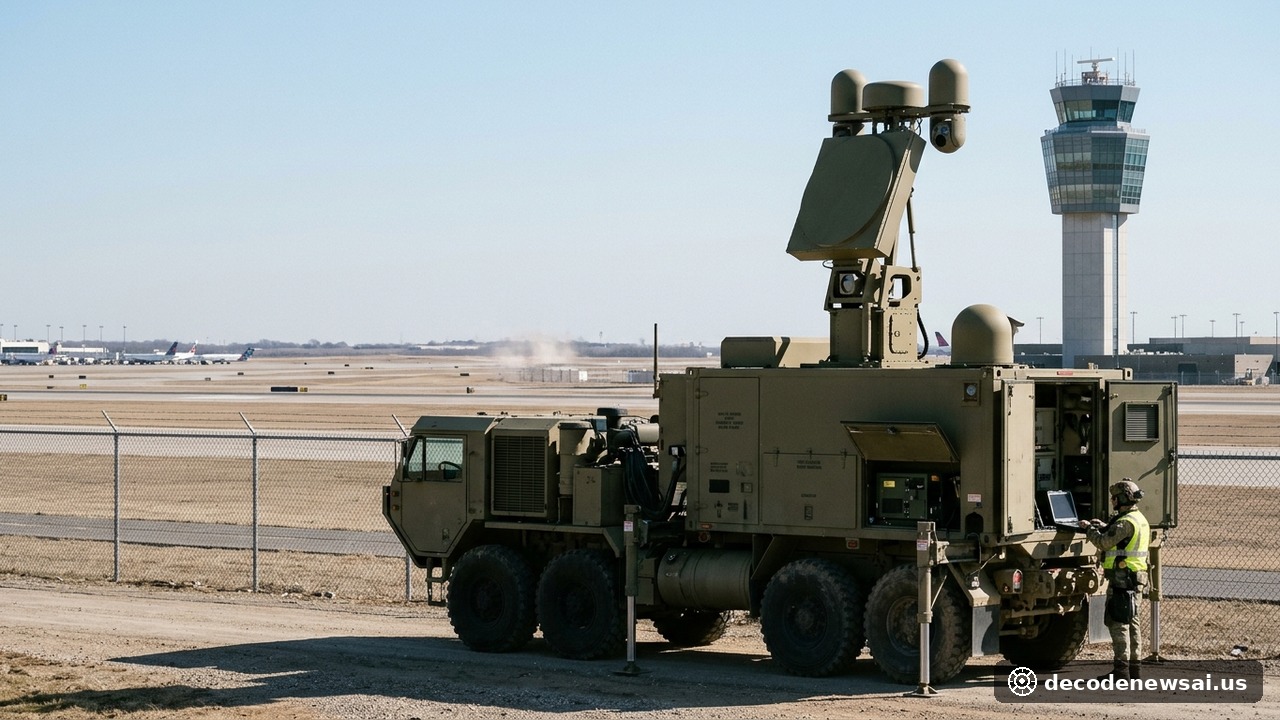
The guidelines require that any kinetic intercept or active electromagnetic jamming within five nautical miles of major commercial airports must utilize automated digital handshakes with FAA air traffic management facilities. Department of War officials confirmed that mobile counter-drone interception units certified under the new protocol will deploy to ten primary international airports before the end of the year. Joint readiness teams will conduct simulated swarm-intrusion drills to test operational deconfliction under live conditions.
An aviation security fellow at the Flight Safety Foundation noted in an industry analysis: "Historically, counter-UAS deployment was stalled by jurisdictional uncertainty between civil aviation authorities, the military, and domestic law enforcement. This five-department agreement eliminates regulatory ambiguity, establishing a robust security umbrella for our national airspace." Interagency training exercises will commence in Nevada early next year.
Aligning Federal Communications Commission Guidelines for Commercial Counter-Drone Innovation
The interagency framework also provides the commercial defense industrial base with clear technical guidelines for developing next-generation counter-drone technologies.
In coordination with the Federal Communications Commission, the participating agencies released a standardized list of controlled frequency exemptions and laboratory testing criteria. The guidance restricts broad-spectrum jamming while providing expedited procurement channels for micro-Doppler tracking radars and precision kinetic interceptors. By publishing transparent technical boundaries, federal authorities aim to stimulate private-sector innovation in low-altitude airspace defense.
A senior defense analyst at the Lexington Institute observed in Arlington: "Clear regulatory standards are essential for modernizing domestic air defense capabilities. By defining explicit technical boundaries, the federal government balances immediate protective needs with long-term technological advancement." Working group technical briefings will open next week in Dallas.
Strategic planning advisors and international trade specialists noted that long-term intergovernmental frameworks generate predictable operating environments across key industry sectors. By coupling transparent administrative guidelines with rigorous scientific benchmarks, regulatory bodies and enterprise leaders establish sustainable operating models capable of withstanding shifting macroeconomic dynamics. Global market participants will continue observing forthcoming implementation milestones as public agencies execute their mandated responsibilities throughout 2027. Cross-border coordination remains vital for driving sustained operational resilience and delivering measurable societal benefits worldwide.
Strategic planning advisors and international trade specialists noted that long-term intergovernmental frameworks generate predictable operating environments across key industry sectors. By coupling transparent administrative guidelines with rigorous scientific benchmarks, regulatory bodies and enterprise leaders establish sustainable operating models capable of withstanding shifting macroeconomic dynamics. Global market participants will continue observing forthcoming implementation milestones as public agencies execute their mandated responsibilities throughout 2027. Cross-border coordination remains vital for driving sustained operational resilience and delivering measurable societal benefits worldwide.