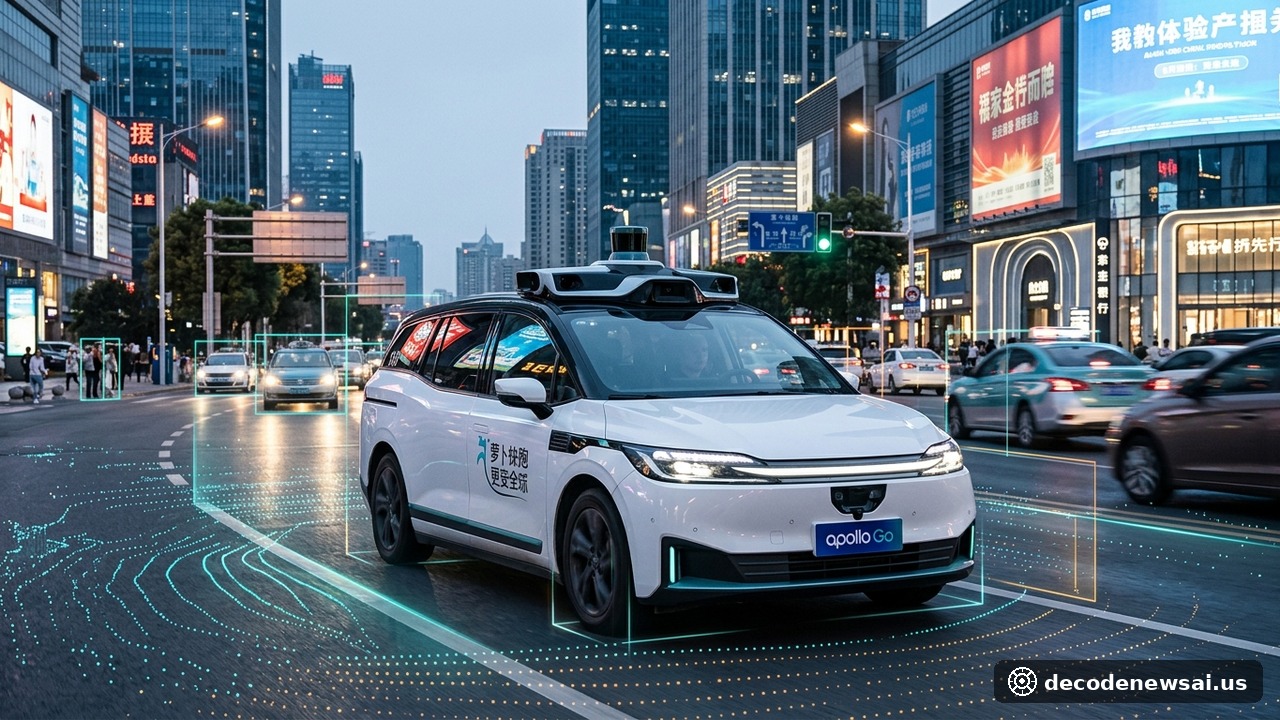
Chinese autonomous mobility pioneer Baidu officially introduced Apollo World in early November 2026, launching a cutting-edge multimodal generative world model capable of simulating interactive driving physics and edge-case street scenarios; the system synthesizes up to 100,000 kilometers (approximately 62,000 miles) of high-fidelity synthetic autonomous testing telemetry daily—equivalent to three years of physical road operations by safety-driver-equipped vehicles—to accelerate global deployment across its Apollo Go driverless commercial platform.
What Key Technical Specifications and Operating Metrics Define Apollo World?
- International Commercial Deployment: Licensed operations in Dubai; European testing;Physical AI Lab Mobility Database
- Long-Term Fleet Scale Projections: Morgan Stanley forecasts 1M robotaxis in China by 2035
How Does Apollo World Solve Long-Tail Autonomous Corner Case Dilemmas?
Achieving robust Level 4 autonomy requires systems to master rare, hazardous scenarios—such as flash storms, unexpected construction detours, errant pedestrian surges, and non-standard heavy equipment—that occur infrequently during physical fleet deployments. Relying solely on physical vehicles to encounter every permutation introduces prohibitive logistical overhead and safety exposure.
Apollo World resolves this bottleneck by coupling generative diffusion architectures with Neural Radiance Fields (NeRF) to synthesize reactive 3D environments. Rather than merely rendering photorealistic camera pixels, the engine models the complex radiative transfer physics governing LiDAR reflectance and radar scatter across changing weather conditions. The neural system simulates dynamic multi-agent interactions at millisecond latency, subjecting vehicle foundation models to millions of severe edge-case permutations within a risk-free computational environment.
Why Does Baidu's Asset-Light Global Expansion Rely on Synthetic Simulators?
Operating the world's most extensive commercial robotaxi service across dense metropolises like Wuhan and Beijing, Baidu is deploying an asset-light international strategy, partnering with localized ride-hailing networks such as Uber and regional logistics fleet operators.
However, exporting autonomous software across international boundaries involves distinct traffic conventions, right-hand versus left-hand driving laws, and diverse urban topologies ranging from Middle Eastern desert highways to historic European thoroughfares. Shipping physical fleets overseas for years of local validation is economically inefficient. Apollo World ingests local geographic survey maps and semantic street imagery, synthesizing hundreds of thousands of locally calibrated training miles in cloud clusters before physical robotaxis touch foreign pavement.
How Will Generative Simulation Architecture Reshape the Global Autonomous Race?
Long-term market projections from Morgan Stanley indicate that China's autonomous vehicle fleet alone could scale to one million operational robotaxis by 2035. As the industry matures, competitive advantages are shifting from raw hardware sensor counts toward algorithmic training velocity and synthetic data generation quality.
Alongside Tesla's end-to-end neural networks and competitive commercial deployments from Waymo, Baidu's deployment of Apollo World demonstrates that high-capacity generative world models are becoming standard infrastructure for commercial Level 4 scaling. By closing the training loop between real-world telematics and simulated edge cases, autonomous vehicle developers are accelerating safety validation timelines, moving closer toward widespread driverless transportation.
How Are Autonomous Vehicle Simulators Accelerating Sensor Hardware Design Cycles?
Beyond software training, generative simulation architectures like Apollo World are fundamentally reshaping automotive hardware prototyping pipelines. By simulating complex optical dispersion, atmospheric scattering, and electromagnetic interference in digital environments, optical engineers can optimize camera lens coatings and LiDAR wavelength specifications without fabricating costly physical hardware iterations.
Automotive systems integrators emphasize that physics-informed world models enable rapid virtual validation across thousands of vehicle chassis configurations. By testing sensor placement geometries and thermal dissipation profiles against synthetic digital twins, autonomous mobility manufacturers compress multi-year research and development cycles into months, lowering the capital threshold required to commercialize Level 4 robotaxi fleets globally.