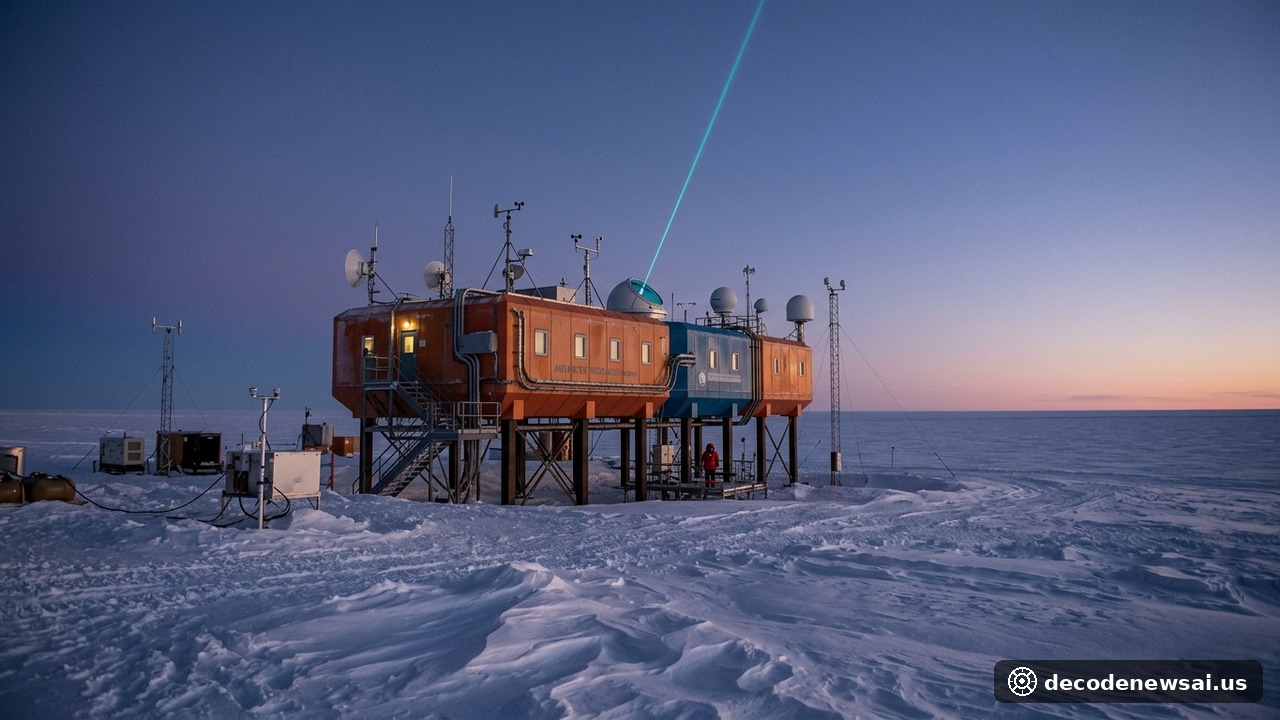
Scientists from the National Aeronautics and Space Administration (NASA) and the National Oceanic and Atmospheric Administration (NOAA) released their annual Antarctic ozone assessment on November 9, 2026, confirming that the 2026 Antarctic ozone hole reached its annual peak in late September. Remote-sensing telemetry gathered by orbital satellite constellations and validated by high-altitude ozonesondes launched from the South Pole Station demonstrated that the ozone hole peaked at a single-day maximum surface area of 22.0 million square kilometers (approximately 8.5 million square miles) on September 28. The data reinforces that multi-decade global phaseouts of ozone-depleting substances continue yielding verifiable planetary atmospheric healing.
OMI and OMPS data show ozone depletion below 108 DU
Atmospheric observations collected by the Ozone Monitoring Instrument (OMI) aboard NASA's Aura spacecraft and the Ozone Mapping and Profiler Suite (OMPS) on the NOAA-20 satellite confirmed that peak depletion levels remained substantially compressed compared to catastrophic extents recorded during the late 1990s and early 2000s, when ozone holes frequently exceeded 28 million square kilometers.
During the height of polar depletion, minimum stratospheric total column ozone values declined to 108 Dobson Units (DU) over the polar cap. Depletion is governed annually by solar radiation reacting with manmade chlorine and bromine reservoirs within extremely cold polar stratospheric clouds.
As seasonal meteorological transitions weakened the Southern Hemisphere polar vortex throughout October, warmer stratospheric air masses circulated into the polar vortex interior, initiating steady natural replenishment across high latitudes.
Montreal Protocol compliance drives 0.8% annual halogen decline
The comprehensive joint federal report underscored that steady stratospheric recovery directly validates international environmental treaties. Since the landmark adoption of the Montreal Protocol in 1987, global treaties systematically banned the production and industrial consumption of chlorofluorocarbons (CFCs) and halons previously ubiquitous in refrigeration and aerosol products.
Ground-based atmospheric sampling stations maintain continuous records indicating that total stratospheric halogen abundances above Antarctica continue declining at an average rate of approximately 0.8% annually, confirming that chlorine concentrations peaked decades ago.
During a presentation at NASA's Goddard Space Flight Center in Greenbelt, Maryland, Dr. Paul Newman, Chief Scientist for Earth Sciences, contextualized the 2026 atmospheric readings within long-term planetary trendlines. Dr. Newman stated: "The 2026 Antarctic ozone hole confirms that continuous international compliance with chemical emission bans is healing our planetary stratosphere."
NASA and WMO project Antarctic ozone recovery around 2066
Advanced supercomputer chemistry-climate modeling developed collaboratively by NASA and the World Meteorological Organization projects that the Antarctic ozone layer will fully recover to pre-1980 benchmark thickness around the year 2066. Federal atmospheric scientists reiterated the imperative of maintaining uncompromised international compliance with global chemical treaties to protect the global biosphere from excessive solar ultraviolet radiation.
Atmospheric research scientists and global environmental policy analysts emphasized that multi-decade stratospheric monitoring demonstrates the tangible success of coordinated international chemical governance treaties. The Montreal Protocol's universal ratification and strict enforcement have established a verifiable template for addressing global planetary atmospheric challenges through legally binding industrial transitions. Long-term telemetry gathered by orbital spectrometers and Antarctic ground stations confirms that natural chemical breakdown processes are steadily clearing historical halogen reservoirs from the upper atmosphere. Atmospheric chemists noted that continuing systematic monitoring remains vital to identify potential unrecorded emissions of ozone-depleting substances and track interactions between stratospheric cooling and global climate shifts. NASA and NOAA continue collaborating with international meteorological agencies to maintain uninterrupted orbital observation capabilities safeguarding the Earth's protective ozone shield.
Climate scientists highlighted that long-term stratospheric monitoring demonstrates the extraordinary efficacy of international chemical restriction pacts. Continued atmospheric data collection by orbiting environmental satellites guarantees that sovereign compliance remains verifiable across all hemispheric regions. The ongoing recovery of the Antarctic ozone hole provides compelling scientific evidence that multilateral environmental cooperation can successfully reverse global planetary atmospheric damage.