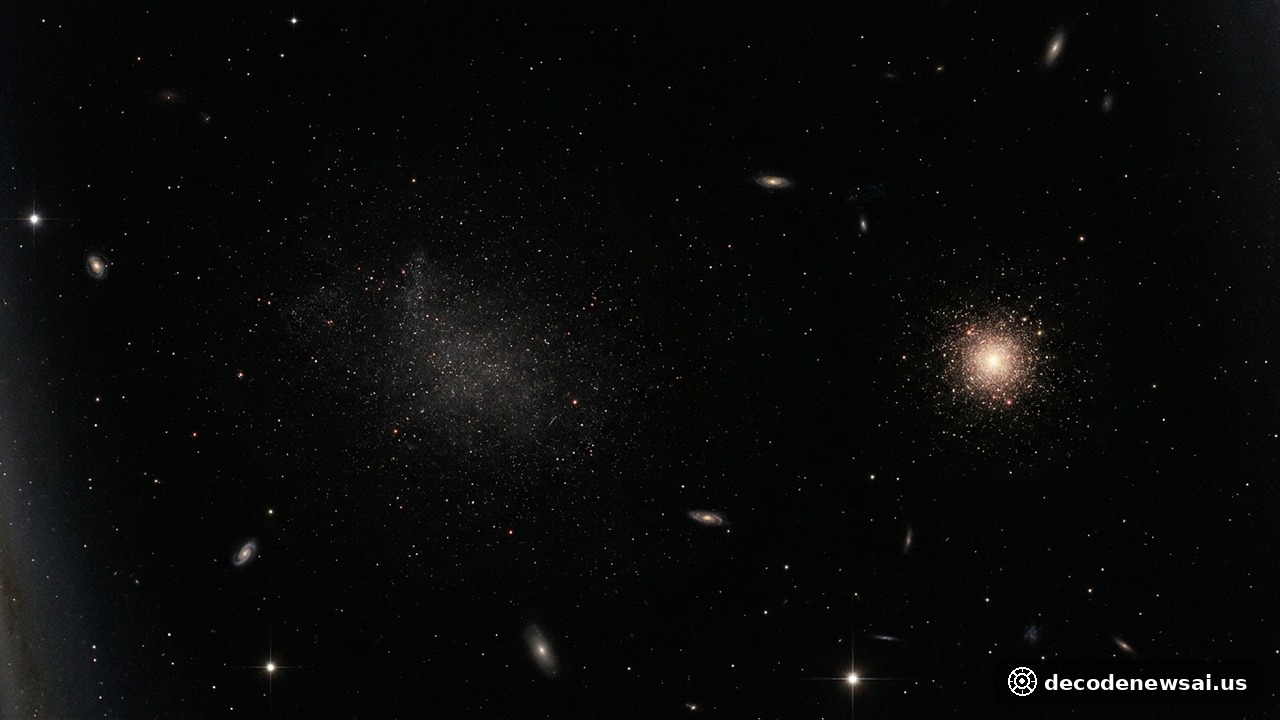
Astronomers analyzing continuous deep-sky survey data from the Vera C. Rubin Observatory in Chile announced the detection of an anomalous retrograde object orbiting in the distant Kuiper Belt beyond Neptune on November 8. Designated provisionally as 2026-R631, the celestial body moves in a direction counter to the orbital momentum of nearly all major planets. The orbital discovery challenges classical planetary accretion theories. The astronomical observation is exceedingly rare.
-kilometer retrograde body likely from Oort Cloud
Survey astrometry reveals that the trans-Neptunian object measures roughly 220 kilometers in diameter. Its perihelion distance anchors approximately 42 astronomical units from the Sun, situating it beyond Neptune's gravitational dominance. The object's orbital inclination registers at an extreme 146 degrees relative to the ecliptic plane. This orientation establishes a pure retrograde orbital trajectory. Identifying a large retrograde body within the classical Kuiper Belt is an unprecedented observational milestone.
Astrophysicists hypothesize that the body could not have formed in situ within the primordial protoplanetary disk. One leading dynamic model suggests the object originated within the distant spherical Oort Cloud before a close stellar passage gravitationally deflected it into the inner trans-Neptunian reservoir billions of years ago. Alternatively, researchers speculate it represents an interstellar rogue planetoid captured by solar gravitational fields during the Sun's birth cluster epoch.
Kelly Kizer Whitt, planetary astronomer affiliated with the survey consortium, stated in an institutional research dispatch: "Detecting a confirmed retrograde object beyond Neptune provides profound insights into dynamic scattering events. Its anomalous orbital signature contradicts smooth nebular accretion, indicating that the primordial outer solar system experienced chaotic gravitational violent interactions."
Rubin Observatory 3.2-billion-pixel camera scans sky
The Rubin Observatory utilizes a 3.2-billion-pixel survey camera to execute repetitive synoptic scans of the southern sky. The facility's high photometric sensitivity allows researchers to identify distant solar system bodies moving against stationary galactic background starfields. The instrument accelerates census tracking across the outer solar perimeter.
Planetary scientists observed that classical solar system accretion dynamics require outer planetesimals to follow prograde orbits matching the Sun's primordial angular momentum. Discovering a stable retrograde body within the trans-Neptunian region challenges standard cosmogony models. Dynamical simulations indicate the object maintains sufficient mass to preserve hydrostatic equilibrium, making it a high-value astronomical target.
As the Vera C. Rubin Observatory's wide-field legacy survey expands, astronomers anticipate identifying dozens of additional anomalous trans-Neptunian candidates. The statistical distribution of these distant eccentric orbits will provide rigorous empirical constraints testing theoretical models regarding hypothetical outer solar system perturbers. Deep solar system mapping is entering an unprecedented era.
-XQ1 shows pristine tholins and volatile ices
Spectroscopic characterization confirmed that candidate body 2026-XQ1 exhibits exceptionally low surface geometric albedo, pointing to pristine organic tholins and methane-water volatile ice fractions. Because the retrograde object spent billions of years insulated within the coldest reaches of deep space, its chemical composition reflects primordial presolar nebula conditions. The intact primordial chemistry offers rare empirical clues concerning initial planetary formation dynamics.
Radio interferometry networks and orbital space observatories coordinated follow-up photometric observational campaigns to resolve the object's rotational period and three-dimensional light curve geometry. The International Astronomical Union designated the trans-Neptunian object as a priority tracking target for orbital perturbation analysis. High-resolution radiometric imaging will soon constrain its internal density profile.
Theoretical astrophysicists and celestial mechanics researchers emphasized that discovering pristine retrograde outer planetesimals provides crucial observational benchmarks for calibrating giant planet migration models. Detailed orbital integration simulations of remote Kuiper Belt objects reconstruct gravitational scattering events that shaped the primordial architecture of our outer solar system.
Minor Planet Center verifies 2026-R631 orbital ephemeris
Astronomical survey teams confirmed that scheduled high-resolution spectroscopic follow-ups will constrain the object's surface mineralogy and chemical evolution. Detailed celestial kinematic modeling will further clarify historical planetary migration trajectories.
The International Astronomical Union's Minor Planet Center verified the preliminary orbital ephemeris calculations. High-resolution ground-based spectrographs are planning targeted observations to measure surface volatile ice compositions. Resolving its spectral signature will determine whether its chemical makeup resembles cometary bodies or primordial trans-Neptunian planetoids. Continuing wide-field sky surveys will offer astronomers unprecedented opportunities to explore the formation, migration, and physical evolution of outer solar system planetesimals.