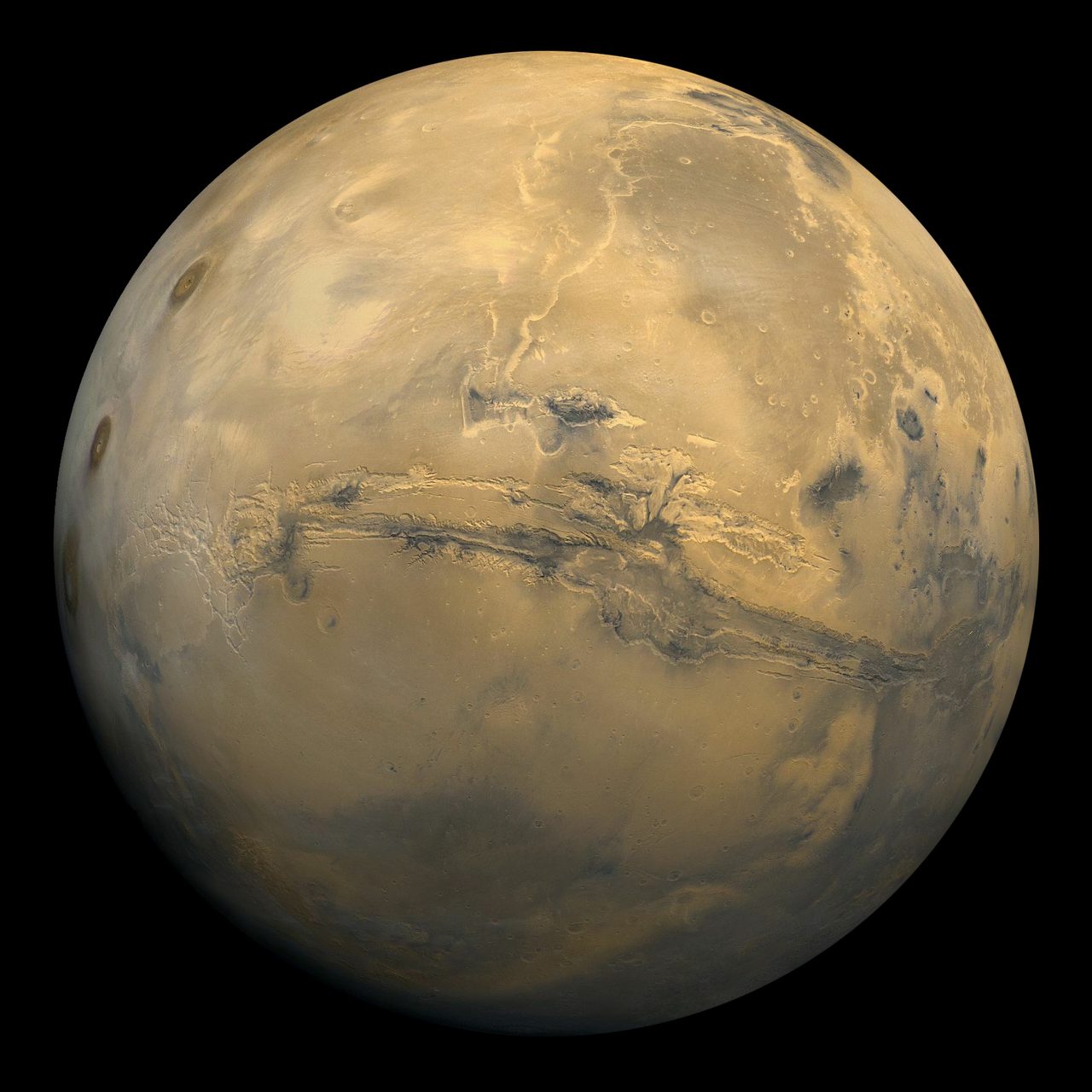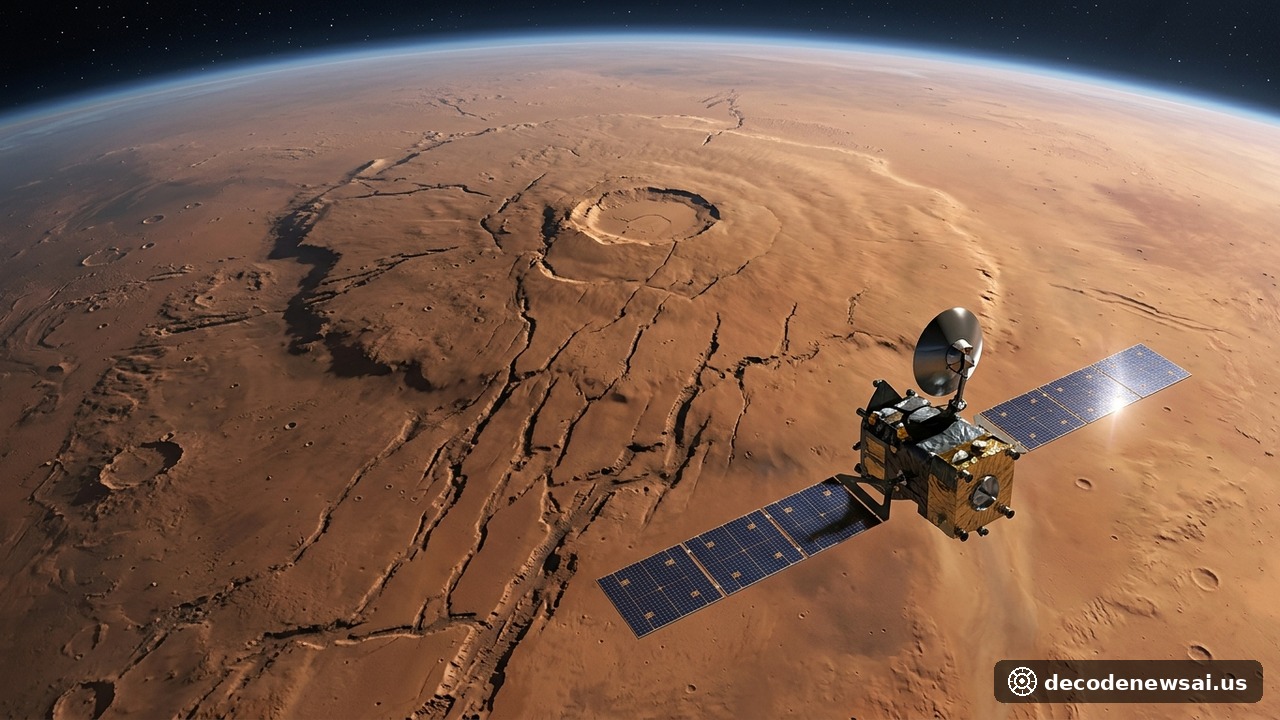
The European Space Agency confirmed that the ExoMars Trace Gas Orbiter detected localized emissions of hydrogen chloride gas above volcanic fissures on Mars. The spacecraft first reported the detection of hydrogen chloride in the Martian atmosphere in 2021. Published in the peer-reviewed scientific journal Science Advances on November 4, 2026, the study provides compelling observational evidence that Mars is not geologically dead but remains volcanically dormant. The findings indicate that active magma chambers may continue to degas from deep within the Martian crust. Seasonal Hydrogen Chloride Spikes Identified Over Alba Mons Fissures Atmospheric scientists identified unexpected chemical variations during early summer in the northern hemisphere of Mars. Under typical Martian conditions, hydrogen chloride concentrations follow a regular seasonal cycle, peaking during northern winter before plunging to negligible levels in summer as global dust and water cycles shift. However, spectroscopic data gathered by the Atmospheric Chemistry Suite revealed recurrent concentrations of hydrogen chloride directly above Alba Mons. Alba Mons is the largest volcano on Mars by surface area, characterized by broad shield slopes. The localized persistence of the gas during early summer contradicted established photochemical models of Martian atmospheric circulation.
High-resolution orbital imagery obtained by the CaSSIS camera on board the orbiter revealed narrow surface fissures extending hundreds of meters across the slopes of Alba Mons. Distinct discoloration patterns surround these fractures, closely mirroring mineral deposits found around volcanic fumaroles on Earth. Researchers determined that Martian winter temperatures falling to minus 120 degrees Celsius allow surface ice to seal the fractured terrain. As temperatures rise in early summer, overlying frost sublimates directly into vapor, allowing subterranean gases to escape into the atmosphere. Geological Evidence Indicates Dormant Subsurface Magma Chambers The localized seepage provides critical support for ongoing endogenic activity within Mars. In our solar system, confirmed active volcanism is restricted to an elite group comprising Earth, Venus, and Jupiter's moon Io. While orbital observations indicate that Olympus Mons experienced volcanic activity within the past two million years, scientists have never observed an active eruption or fresh lava flow on the Martian surface. Daniel Mège, planetary scientist at the Space Research Centre of the Polish Academy of Sciences and co-lead author of the paper, stated: "The Trace Gas Orbiter was able to find the smoking gun. It was like looking for a needle in a haystack. It's truly amazing that it spotted a handful of molecules from a perhaps intermittent source, whilst moving continuously along its orbit to monitor the whole martian atmosphere."
The international research team systematically evaluated all plausible atmospheric chemical mechanisms and surface dust reactions before attributing the gas to a volcanic origin. Subsurface magmatic degassing emerged as the only consistent physical explanation for the observed spatial clustering. Alexander Trokhimovskiy, study co-lead author from the Space Research Institute of the Russian Academy of Sciences, explained: "It is released from chlorine-bearing compounds dissolved in magma as magma rises and pressure decreases. Its presence can, therefore, be consistent with magmatic degassing." He added: "It suggests that the planet's interior may still retain sufficient heat to sustain magmatic processes, and that atmospheric trace gases can provide a way to detect and investigate geological activity that is otherwise difficult to observe directly." Hydrothermal Environments Open Promising Prospects for Astrobiology The presence of residual magmatic heat carries major implications for astrobiological exploration on Mars. During the Hesperian epoch between 3.7 and 3 billion years ago, intense volcanic outgassing contributed to a denser atmosphere and widespread liquid water. Today, rising magma encountering deep permafrost or groundwater reserves could generate localized hydrothermal networks. On Earth, hydrothermal vents represent primary candidate environments for the early emergence of cellular life, supplying chemical energy while shielding organisms from cosmic radiation.
Trokhimovskiy emphasized the significance of these warm subsurface environments: "As rising magma moves through the crust, it can encounter, melt and heat underground water, creating environments shielded from the harsh surface conditions. Such active hydrothermal systems may provide the energy sources and favourable conditions needed to support microbial life. This makes warm subsurface environments one of the most promising targets in the search for life on Mars." Colin Wilson, project scientist for the ExoMars Trace Gas Orbiter at the European Space Agency, emphasized: "These findings may prove to be TGO's greatest success yet." Future orbital observation campaigns will monitor subsequent Martian summers to trace the full extent of this subterranean outgassing.