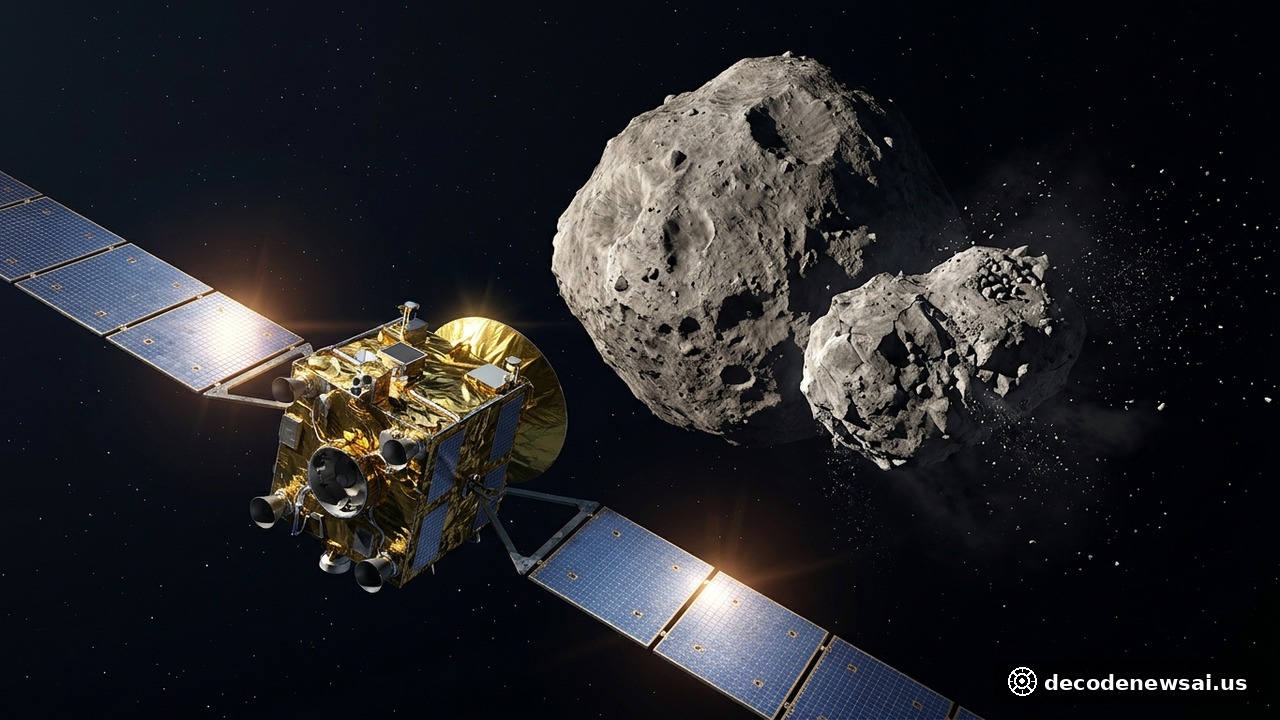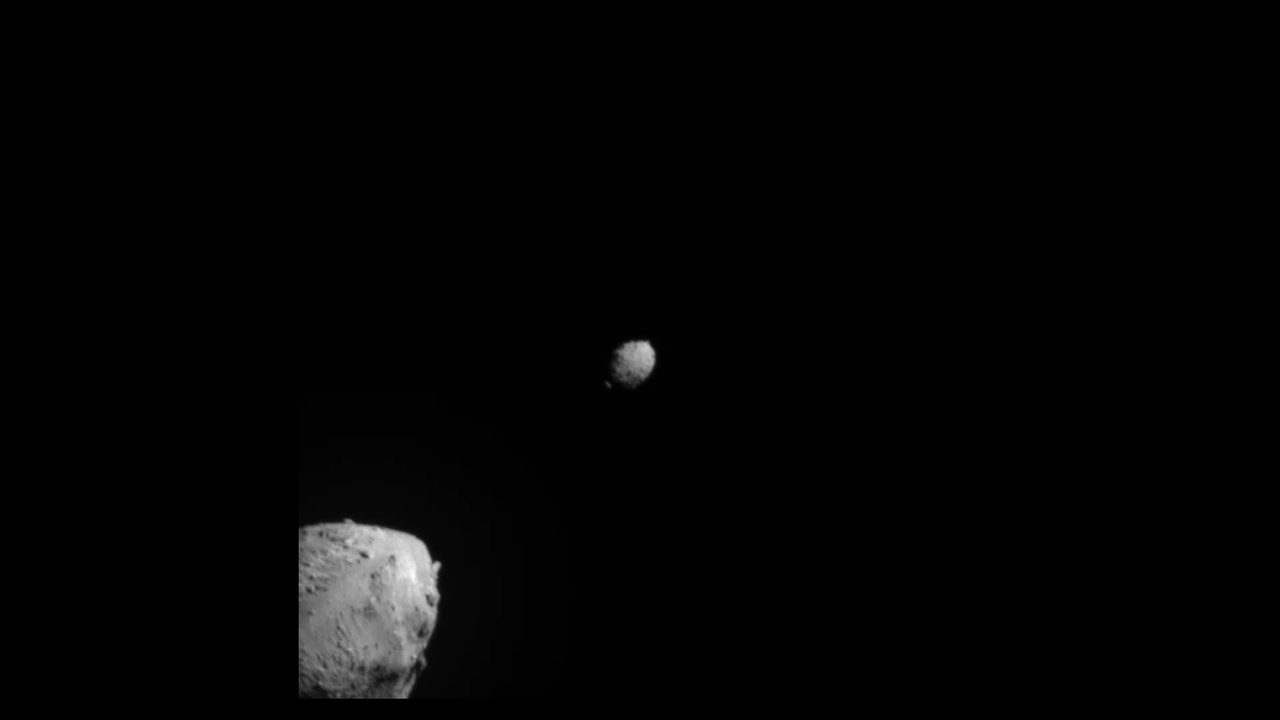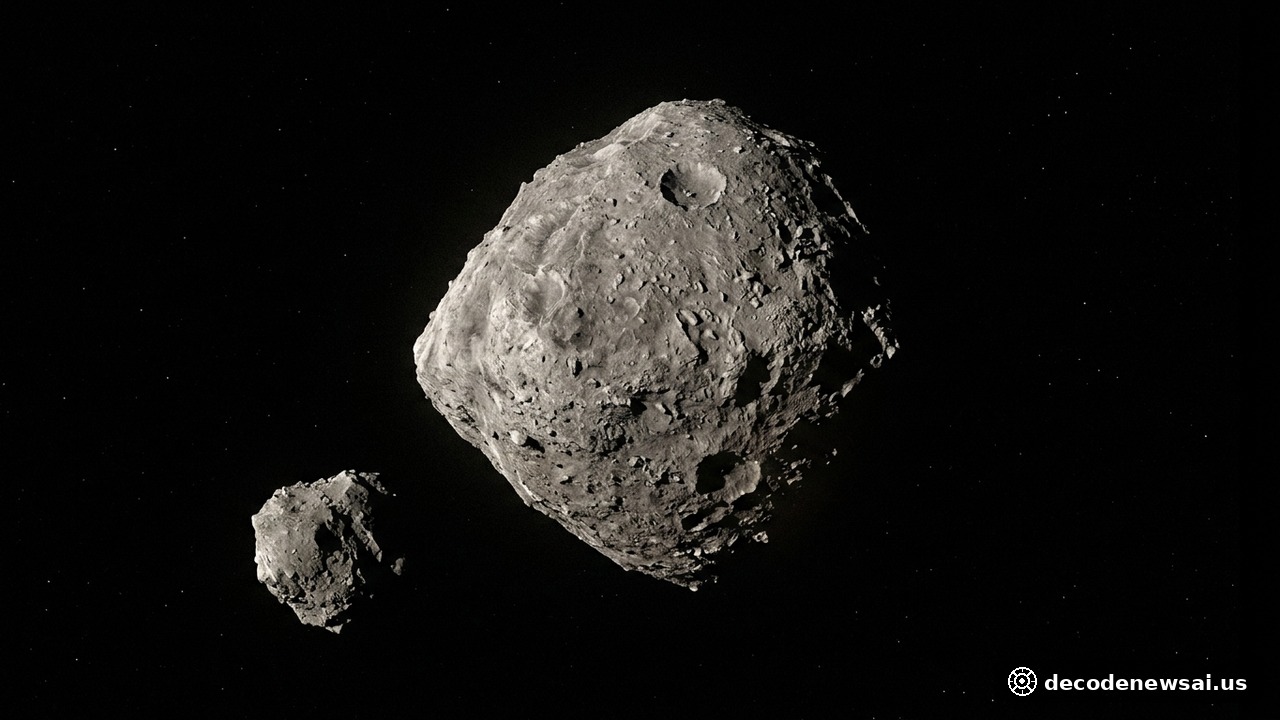
The European Space Agency (ESA) officially released the inaugural close-up imagery captured by its flagship planetary defense probe, Hera, on November 5, 2026, marking humanity's first direct visual return to the binary asteroid system following NASA's historic Double Asteroid Redirection Test (DART) kinetic impact. Operating approximately 196.8 million kilometers from Earth after completing an intensive two-year interplanetary cruise and braking campaign, the 1,128-kilogram spacecraft resolved the 780-meter-wide primary asteroid Didymos alongside its 151-meter-wide moonlet Dimorphos from a proximity of just 60 kilometers, unveiling previously unseen geological features on Didymos's unmapped hemisphere that provide crucial forensic clues regarding the chaotic aftermath of the 2022 hypervelocity cosmic collision.
What Are the Quantifiable Upstream Metrics and Orbital Parameters in Hera's Didymos Encounter?
- Spacecraft Launch Milestone and Total Wet Mass: Launched October 7, 2024 via Falcon 9; 1,128 kg
- Orbital Period Reduction Induced by 2022 NASA DART Impact: Shortened by ~33 Minutes (Significantly Above Simulations)
Hera Principal Investigator Patrick Michel expressed profound excitement during the mission briefing at ESA's European Space Operations Centre, declaring: "The first thing we said was 'Wow!' This is the other side of Didymos from the one that DART's camera showed us shortly before impact, so this feels like looking at a whole new world." Captured via the monochromatic Asteroid Framing Camera, the imagery demonstrates that while Didymos exhibits its characteristic equatorial bulge, its previously unmapped hemisphere displays a chaotic landscape populated by high-standing boulders, ancient impact basins, and mysterious linear trench systems. Mission scientist Michael Kueppers explained that these morphological formations likely represent secondary impact gouges carved by boulders blasted across one kilometer of vacuum when DART slammed into Dimorphos at 6.1 kilometers per second.
The imaging sequence confirmed the total success of complex terminal deceleration maneuvers executed throughout late October, which systematically curtailed Hera's relative approach speed from over 12 kilometers per second down to roughly 20 meters per second.
How Will Deployable CubeSats Juventas and Milani Conduct Internal Asteroid Forensics?
Hera's scientific mission represents far more than a passive photographic reconnaissance flyby, functioning instead as a structured forensic investigation of kinetic deflection mechanics.
Throughout November and December 2026, the mothership will execute close-proximity orbital insertion, stepping down from 30 kilometers to within 10 kilometers of the celestial bodies. In mid-December, Hera will deploy two autonomous six-unit CubeSats: Juventas and Milani. Juventas will deploy a low-frequency monostatic radar to sound the internal macro-porosity and structural coherence of Dimorphos, while Milani utilizes a specialized hyperspectral imaging spectrometer to map mineralogical composition across the artificial impact crater. The data will verify whether Dimorphos behaves as a solid monolithic body or a loosely aggregated gravitational rubble pile.
What Are the Far-Reaching Implications for Global Planetary Defense and Asteroid Deflection?
Hera's initial close-up return elevates planetary defense engineering from an empirical proof-of-concept into a predictive, validated discipline capable of protecting human civilization from catastrophic celestial impacts.
Historically, astronomers relied upon terrestrial radar returns to infer the post-impact momentum transfer multiplier (the Beta factor). By measuring the exact mass, internal density distribution, and crater geometry left by DART, Hera transforms kinetic impact modeling from an educated estimate into an exact science. With ESA scheduling the formal public release of comprehensive 3D global topological maps for November 25, 2026, the mission establishes an enduring operational baseline for safeguarding planetary security against hazardous near-Earth objects.