Community colleges across the United States expanded specialized semiconductor technician certification programs between November 7 and 8 to address an impending workforce shortage of 67000 skilled technicians. Regional economic development boards deployed dedicated vocational grants to expand cleanroom training labs. Domestic fabrication plants are nearing operational commercial deployment. Specialized industrial hiring competition intensified.
TSMC Arizona and Samsung Texas drive cleanroom specialist demand
Projections released by the Semiconductor Industry Association indicate that multi-billion-dollar wafer fabrication expansions by Taiwan Semiconductor Manufacturing Company in Arizona, Samsung Electronics in Texas, and Intel in Ohio have created unprecedented demand for cleanroom equipment specialists. Traditional four-year university electrical engineering degrees emphasize silicon design rather than the hands-on mechanical maintenance required inside advanced fabrication cleanrooms.
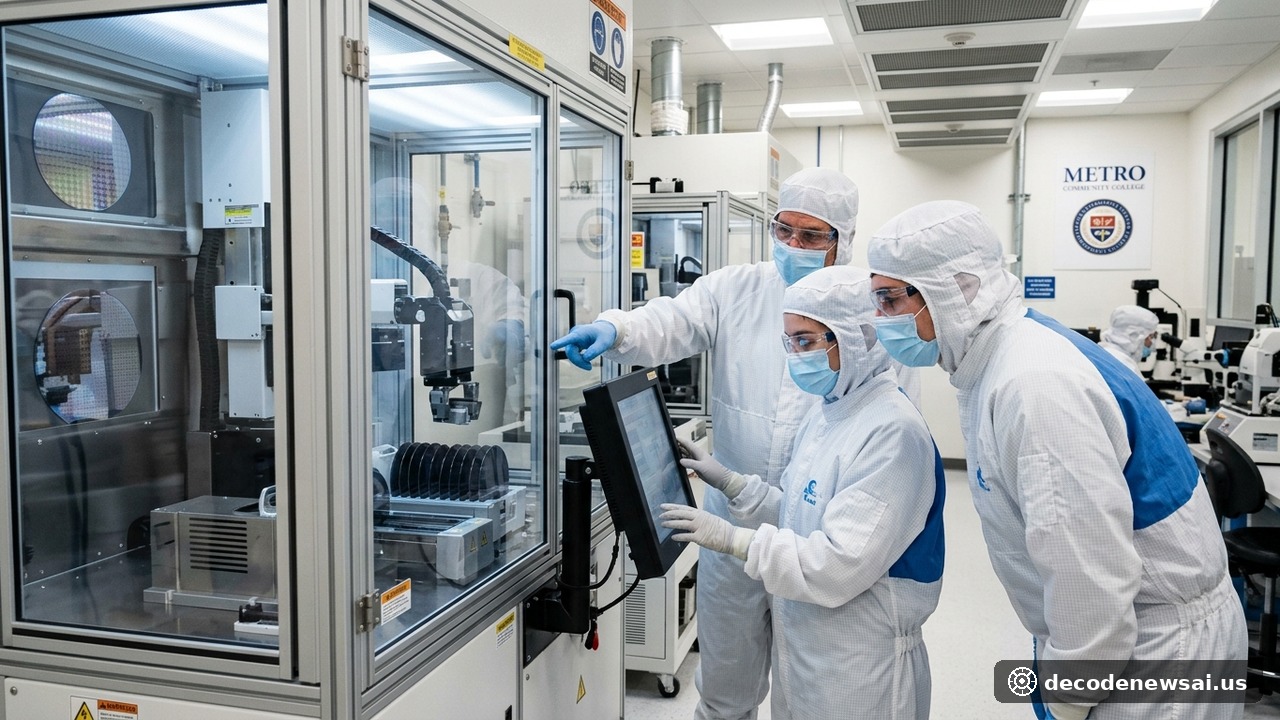
Institutions including Rio Salado College in Arizona and community technical campuses in Ohio established accelerated sixteen-week manufacturing technology pathways. Curriculums emphasize vacuum deposition maintenance, ultra-pure chemical handling, and electrostatic discharge controls. Graduates transition directly into apprentice roles with certified starting placement rates exceeding 90 percent.
Michael Hoffman, workforce education director for regional semiconductor partnerships, stated during a regional workforce summit: "Manufacturing advanced silicon requires thousands of disciplined technicians capable of maintaining complex photolithography and plasma etching tools. Community colleges serve as the critical human capital pipeline sustaining the semiconductor industrial base."
Commerce CHIPS grants equip vocational cleanroom labs
The Department of Commerce CHIPS Program Office distributed direct laboratory equipment grants to participating vocational consortia. Industrial equipment partners donated decommissioned wafer transport tracks and automated cleanroom robotics to facilitate practical laboratory learning. Structured public-private apprenticeships reduce onboarding latency for industrial employers.
Semiconductor foundry executives noted that cleanroom operations require intense technical discipline and procedural precision. By building functional simulated cleanroom training environments on campus, community colleges familiarize vocational students with gowning protocols and airflow lock maintenance on day one. Pre-employment socialization reduces post-hire operational attrition significantly across fabrication facilities.
State economic councils and industrial consortia launched dedicated technical scholarships to reimburse tuition for graduates who commit to multi-year employment agreements with regional foundries. Technical campuses throughout the Midwest are licensing the curriculum. The expansion of advanced domestic manufacturing represents the most significant workforce development milestone in decades.
Foundries recruit community college graduates for packaging roles
As semiconductor fabrication infrastructure accelerates domestically, expanding packaging and assembly cleanroom facilities are implementing rigorous technical screening standards for incoming technicians. Advanced packaging operations located across the American Southwest are actively recruiting vocational graduates directly from certified community colleges. Technical compensation packages remain highly competitive, particularly for specialists trained in chemical mechanical polishing and vacuum chamber maintenance.
Workforce development taskforces tracking critical industrial sectors reported that over eighty-five percent of surveyed semiconductor foundry operators plan to expand formal apprenticeship cohorts over the next three fiscal cycles. The Department of Labor recently approved comprehensive national competency standards for microelectronics maintenance technicians. Aligning community college curriculums with immediate cleanroom operational demands builds a resilient workforce pipeline.
Regional manufacturing alliances emphasized that institutionalizing direct career pipelines from community colleges to semiconductor fabrication facilities creates vital upward economic mobility across working-class manufacturing corridors. Sustainable technical education infrastructure provides dependable local talent pipelines, anchoring high-value domestic advanced industrial manufacturing.
Entry-level technician hourly wages rose nearly 20 percent
Vocational educators and industrial leaders confirmed that expanded apprenticeship initiatives will receive continuous state funding support. Preparing skilled technicians ensures domestic microelectronics manufacturing facilities meet ambitious production targets over the coming decade.
Workforce economists observed that competitive starting wages and stable technical career ladders have attracted military veterans and former automotive factory personnel. As commercial wafer foundries prepare for commercial volume manufacturing in 2027, entry-level technician hourly wages rose nearly 20 percent. Targeted vocational workforce development provides the foundational talent necessary for domestic industrial resilience. Workforce development experts emphasized that strong, sustained collaboration between academic institutions and high-tech industrial employers will solidify domestic semiconductor leadership for generations to come.