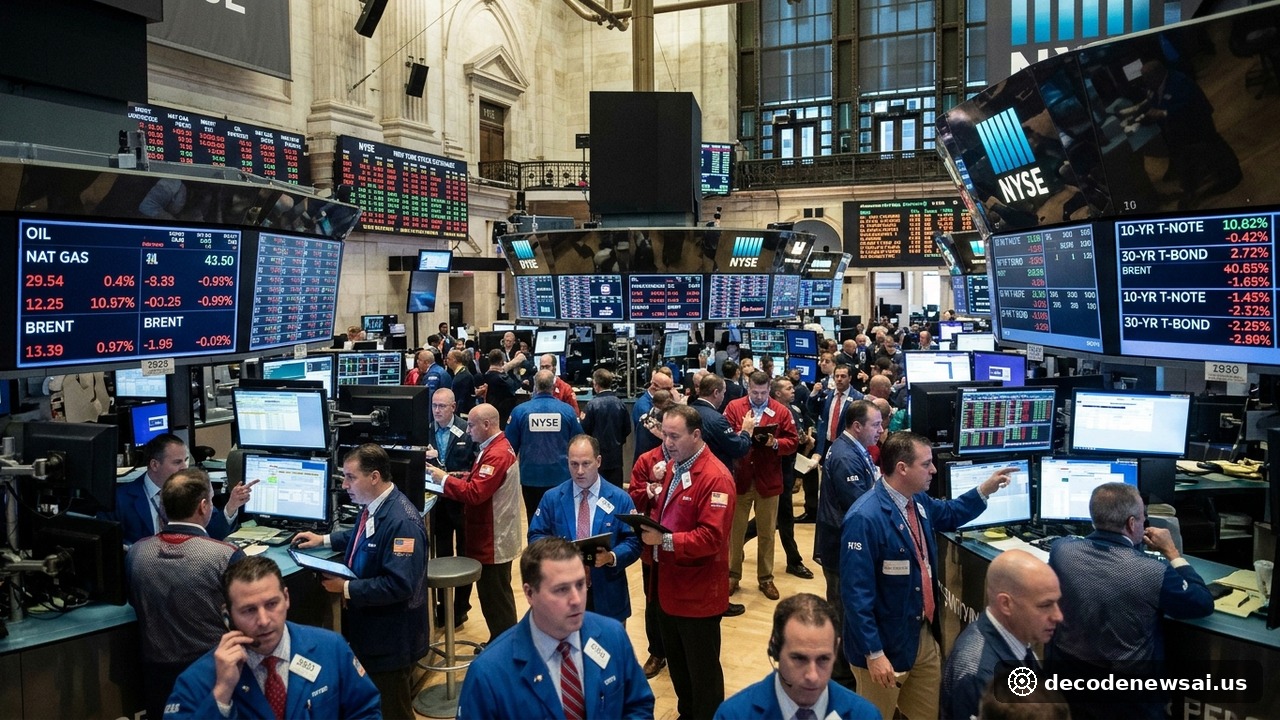
The United States Treasury market underwent a pivotal repricing on Friday following a turbulent election week across global financial markets. On November 6, 2026, the benchmark 10-year US Treasury note yield ticked up to settle at 4.86 percent, rising from 4.84 percent late Thursday. Overnight, the benchmark rate had briefly dipped to its lowest level since September 9 as equity market turmoil spurred haven bids. However, a blowout October non-farm payrolls report released Friday morning shifted sentiment, prompting Wall Street to reassess Federal Reserve policy expectations. The strong labor data curtailed market hopes for monetary easing and rate cuts, lifting the market-implied probability of a December Fed interest rate hike to near 77 to 78 percent while investors digested the long-term fiscal deficit implications of a divided Congress. Blowout Payrolls Dismantle Rate-Cut Expectations as December Hike Odds Surge Data published Friday by the United States Bureau of Labor Statistics revealed unexpected resilience across the domestic economy. Non-farm payrolls increased by 165,000 jobs in October, well above the prior 12-month average monthly gain of 48,000 and substantially topping market forecasts of 65,000. In addition, the Labor Department revised August and September payroll figures upward to 186,000 and 60,000, respectively. The national unemployment rate held steady at a solid 4.1 percent. Average hourly earnings advanced 0.4 percent month-over-month and 3.1 percent compared to the prior year, preventing an anticipated slowdown in annual wage growth below 3 percent from occurring.
The robust employment print curtailed bond investor bets on an impending Federal Reserve easing cycle. According to CME FedWatch data, interest rate futures priced a 76.8 percent probability of a 25-basis-point rate hike at the December 8 to 9 policy meeting, up from 66.9 percent a week earlier. Data from Reuters and LSEG similarly placed December rate hike probabilities at approximately 78 percent. The Federal Reserve previously raised its policy target range by a quarter point in September to 3.75 percent to 4.00 percent, maintaining that stance at its October 28 meeting. A December hike would elevate the federal funds target range to 4.00 percent to 4.25 percent. San Francisco Fed President Mary Daly told CNBC on Friday: "My expectation is, we're going to have to tighten policy further." Daly described the recent tech-stock repricing as "painful" but "orderly." St. Louis Fed President Alberto Musalem also noted that artificial intelligence infrastructure investments "will continue to contribute to inflation." Yield Curve Diverges as Long End Weighs Deficit Dynamics and Political Gridlock Treasury pricing exhibited clear divergence across the yield curve. The policy-sensitive 2-year Treasury yield rose from 4.46 percent to 4.51 percent on Friday, reflecting near-term policy expectations. Meanwhile, the benchmark 10-year Treasury yield settled at 4.86 percent, and the 30-year bond yield closed at 5.26 percent. As a result of the sharper rise at the short end, the yield gap between 2-year and 10-year Treasury notes narrowed from 47 basis points to 35 basis points.
The long end of the yield curve reflected crosscurrents surrounding federal fiscal policy and debt supply following the US midterm elections. The 10-year yield had previously climbed to an intraperiod high of 5.31 percent on October 5, driven by investor concerns over persistent inflation, elevated rates, and government borrowing. Earlier in the week, Democratic congressional victories spurred bond rallies on hopes that divided government in Washington would impose legislative gridlock, limiting federal spending and debt expansion. Nevertheless, President Donald Trump stated he would exercise veto powers if Congress refused to cooperate, leaving the fiscal deficit trajectory uncertain. Equity Markets Rebound as Investors Calibrate Valuation and Debt Pressures Shifting rate expectations and Treasury moves spilled into equity markets. Major Wall Street stock indices stabilized following Thursday's severe sell-off. The S&P 500 gained 23.13 points, or 0.31 percent, to close at 7,376.86, trimming its weekly decline to 2.7 percent. The Nasdaq Composite rebounded 264.43 points, or 1.1 percent, to finish at 24,579.42, though it remained down 3.4 percent on the week in correction territory. The Dow Jones Industrial Average slipped 237.33 points, or 0.46 percent, to end at 51,285.73, registering a 0.9 percent weekly decline. The Philadelphia Semiconductor Index gained 4.2 percent on Friday after falling more than 12 percent on Thursday, with Nvidia advancing 2.8 percent and chipmakers AMD, Intel, and Micron Technology closing up between 5 percent and 11 percent.
Gerry Sparrow, president and portfolio manager at Sparrow Capital Management, observed: "Most of the disruption of the AI buildout will not probably occur but it's just the uncertainty of the change in government from Republican-led to Democratic-led, not only at the federal level but the state, local levels," adding: "That's causing some disruption in the expectations of investors...the volatility around elections or any political event, whether it be war or terrorist attack, is always going to disrupt the market." Separately, the preliminary University of Michigan consumer sentiment survey rose from 48.0 to 51.0 in November; year-ahead inflation expectations eased from 4.7 percent to 4.3 percent, and long-run inflation expectations fell to 3.4 percent. Investors now look ahead to the October consumer price index release on November 10 to gauge the Fed's policy path.