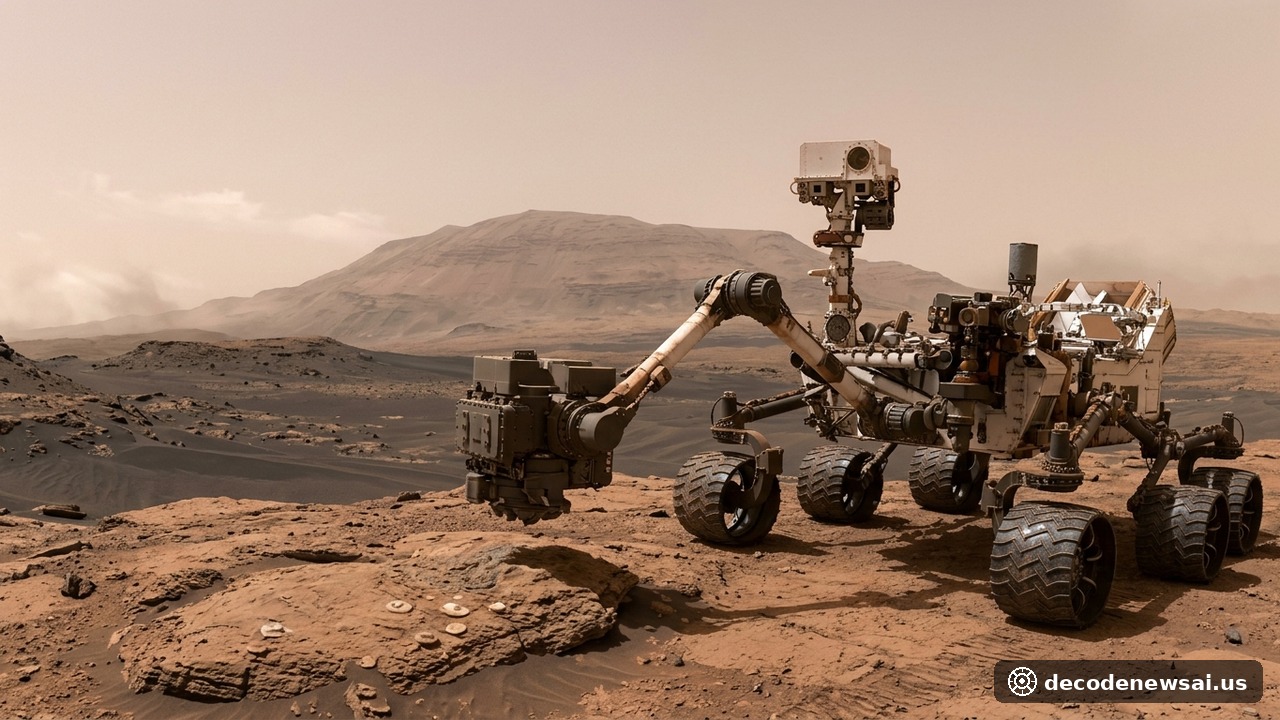
NASA's Curiosity Mars rover science team confirmed on Tuesday, November 10, 2026, that the robotic explorer is finalizing surface characterization at its designated 49th drill target on the Red Planet, informally named Nazca. Positioned along the sulfate-bearing geological strata of Mount Sharp within Gale Crater, the target presents distinctive mineralogical textures that provide critical scientific insights into the historical transition of Mars from an ancient water-bearing planetary environment into a hyper-arid desert world.
MAHLI images reveal disk and needle crystals
High-resolution close-up imagery acquired by the Mars Hand Lens Imager (MAHLI), positioned on the turret of Curiosity's robotic arm, revealed intricate disk-shaped and needle-like mineral crystal formations across the rock outcrop.
In a planetary science research bulletin published from NASA's Jet Propulsion Laboratory in Pasadena, an executive planetary geologist associated with the Curiosity mission highlighted the investigation's scientific importance. The researcher stated: "The disk-shaped pseudomorph formations identified at the Nazca drill target preserve invaluable chemical records of evaporating surface waters and changing fluid temperatures. Analyzing pristine subterranean powder allows our team to reconstruct ancient geochemical evolution with unprecedented fidelity."
Planetary geologists hypothesize that the distinctive textures originated as crystalline minerals precipitated out of hypersaline brine solutions during progressive water evaporation epochs. Over geological timeframes, original mineral crystals were replaced by secondary minerals, forming structural pseudomorphs that preserve original crystal geometries while substituting chemical compositions.
Curiosity drills rock powder for CheMin analysis
Curiosity's science payload will execute shallow rotary-percussive drilling to extract unweathered rock powder from several centimeters below the rock surface. The acquired drill tailings will be delivered directly into the rover's internal Chemistry and Mineralogy (CheMin) instrument for definitive X-ray diffraction mineral identification.
Operating on the surface of Mars for over 5,000 Martian sols since its historic landing in August 2012, Curiosity continues to operate well beyond its primary baseline mission duration. The ongoing ascent of Mount Sharp systematically chronicles billions of years of sedimentary deposits.
Furthermore, space exploration researchers and comparative planetology fellows observed that geochemical measurements across Gale Crater illuminate the atmospheric preservation of early terrestrial planets. By comparing surface chemical coatings with core rock tailings, autonomous exploration systems provide ground truth validation for orbital remote sensing assets. Aerospace engineering teams look forward to continued scientific discoveries from the Martian surface.
Sulfate strata offer benchmarks for climate transitions
In addition, planetary geochemists and robotic space exploration researchers emphasized that detailed mineralogical profiling of sulfate-rich Martian strata provides crucial benchmarks for evaluating historical planetary climate transitions. By analyzing pristine crystalline rock powder extracted from beneath the radiation-exposed surface, scientific teams can deduce the precise fluid dynamics and ionic concentrations of ancient lakes in Gale Crater. Aerospace research institutes commended Curiosity's sustained operational excellence.
Furthermore, comparative planetologists observed that investigating secondary mineral pseudomorphs deepens humanity's comprehension of habitability thresholds across terrestrial planets. The technological endurance of NASA's rover sets an inspiring precedent for future autonomous sample-collection missions across our solar system. Planetary science communities look forward to forthcoming laboratory telemetry from Mount Sharp.
In conclusion, planetary geology researchers and robotic exploration engineers affirmed that in-depth geochemical investigations on Mount Sharp continue to illuminate the ancient environmental history of the Red Planet. Scientists look forward to analyzing returned drilling telemetry to decode the geological evolution of ancient Martian aqueous systems.
Comparative profiling links surface coatings to ancient hydrology
Moreover, deep-space mission controllers and astrobiology research fellows affirmed that comparative geochemical profiling between superficial rock coatings and deep borehole samples yields fundamental clues regarding ancient Martian hydrology. Autonomous robotic exploration continues to expand humanity's understanding of planetary habitability across the solar system. Planetary scientists and deep-space mission specialists look forward to forthcoming laboratory results to unlock the ancient geological history of Mars.