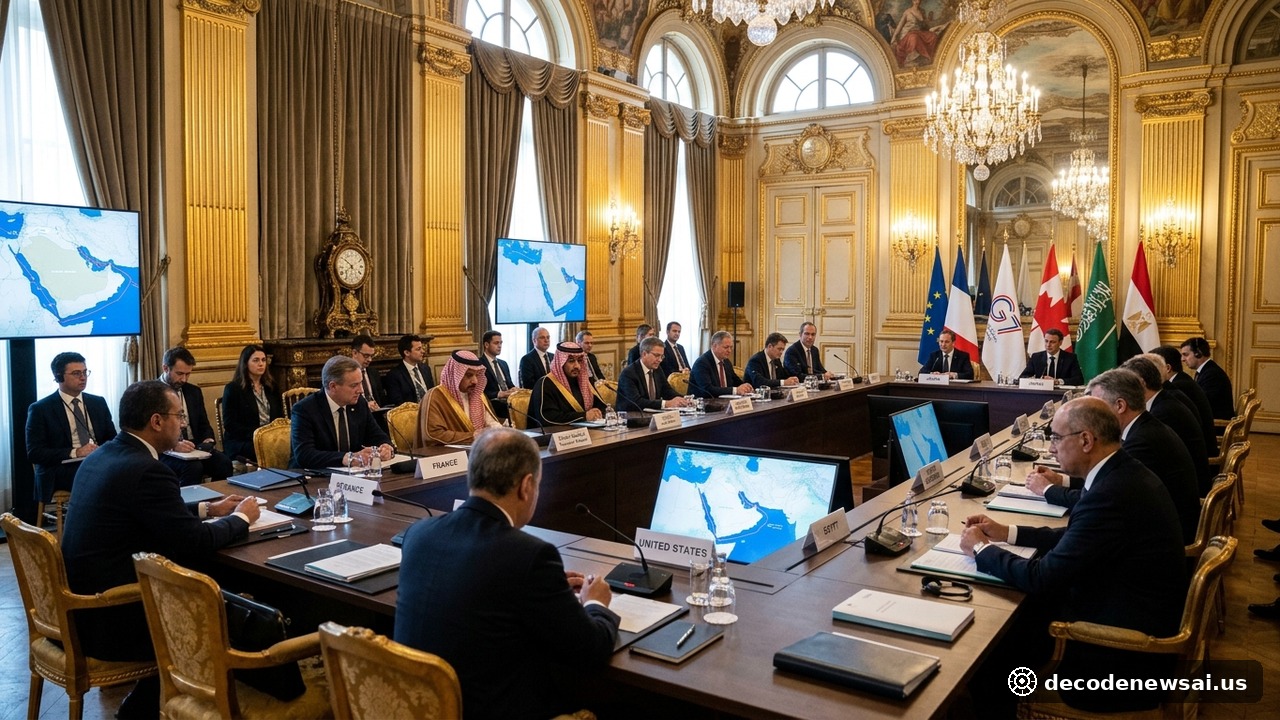
Foreign ministers from the Group of Seven (G7) nations, alongside the foreign ministers of Saudi Arabia and Egypt, concluded high-level multilateral discussions on Middle East regional security in Paris on November 10, 2026. The expanded ministerial session focused squarely on establishing post-UNIFIL security arrangements in southern Lebanon and safeguarding commercial transit corridors through the Red Sea and the Bab el-Mandeb strait.
Addressing Lebanon Defense Architecture as UNIFIL Mandate Nears Expiration
The high-level diplomatic gathering addressed growing concerns regarding the impending expiration of the United Nations Interim Force in Lebanon (UNIFIL) mandate scheduled for late 2026. UNIFIL currently deploys approximately 7,500 peacekeepers from nearly 50 contributing nations along the Blue Line.
French Foreign Minister Jean-Noël Barrot, who chaired the expanded session at the Quai d'Orsay, emphasized that international partners must coordinate closely to avoid dangerous security gaps. The ministers agreed that the Lebanese Armed Forces (LAF) must be systematically reinforced with technical and logistical assistance to assume full sovereign control over border sectors.
French Foreign Minister Jean-Noël Barrot stated during a press briefing following the summit: "G7 foreign ministers agreed on the urgent need to avoid a security void in southern Lebanon after the UNIFIL mission mandate concludes. Moving rapidly toward a robust, verifiable regional security architecture is vital to preventing renewed cross-border hostilities."
Coordinating Maritime Transit and Protection Across Bab el-Mandeb and Hormuz
Beyond ground security in the Levant, the ministerial consultations dedicated extensive attention to persistent threats against international commercial shipping across strategic maritime choke points. Ministers examined collaborative protocols linking European naval task forces with Gulf maritime commands.
Egyptian Foreign Minister Badr Abdelatty and Saudi Foreign Minister Prince Faisal bin Farhan highlighted that uninterrupted maritime passage through the Red Sea is essential for global supply chain predictability and regional economic stability. The delegations affirmed that commercial navigation rights under international maritime conventions must be respected by all regional littoral states.
A senior diplomatic representative from the Saudi Ministry of Foreign Affairs commented in Paris: "Securing maritime transit through the Red Sea and the Persian Gulf represents an indispensable prerequisite for global energy security. Structured diplomatic dialogue and multilateral coordination offer the only viable path to de-escalating naval tensions."
Fostering Inclusive Political Frameworks to Anchor Sustainable Regional Stability
The participating delegations recognized that tactical military coordination must be reinforced by sustained political dialogue addressing the root causes of regional volatility. The G7 and Arab partners pledged to coordinate humanitarian assistance programs supporting displaced civilian populations.
Ministers agreed to establish dedicated diplomatic follow-up channels to maintain institutional contact ahead of the transition of the G7 rotating presidency to the United States on January 1, 2027. Ongoing multinational engagement reflects a shared commitment to building institutional guardrails that protect international commerce and preserve fragile ceasefires across the broader Middle East.
A senior Middle East geopolitical analyst in Paris remarked that the joint G7 and Arab ministerial consensus establishes an essential diplomatic buffer, demonstrating collective resolve to prevent regional conflict escalation.
Strategic planning advisors and international trade specialists noted that long-term intergovernmental frameworks generate predictable operating environments across key industry sectors. By coupling transparent administrative guidelines with rigorous scientific benchmarks, regulatory bodies and enterprise leaders establish sustainable operating models capable of withstanding shifting macroeconomic dynamics. Global market participants will continue observing forthcoming implementation milestones as public agencies execute their mandated responsibilities throughout 2027. Cross-border coordination remains vital for driving sustained operational resilience and delivering measurable societal benefits worldwide.
Strategic planning advisors and international trade specialists noted that long-term intergovernmental frameworks generate predictable operating environments across key industry sectors. By coupling transparent administrative guidelines with rigorous scientific benchmarks, regulatory bodies and enterprise leaders establish sustainable operating models capable of withstanding shifting macroeconomic dynamics. Global market participants will continue observing forthcoming implementation milestones as public agencies execute their mandated responsibilities throughout 2027. Cross-border coordination remains vital for driving sustained operational resilience and delivering measurable societal benefits worldwide.