The National Aeronautics and Space Administration announced the launch of the Advanced Megawatt Propulsion for Exploration and Robotic Expeditions (AMPERE) Challenge on November 9, 2026. The technology incentive competition establishes a total cash prize purse of $500,000 to foster domestic commercial innovation in high-power electric rocket propulsion architectures. The multi-phase competition seeks to stimulate commercial aerospace solutions capable of propelling next-generation robotic explorers and human cargo transfer vehicles throughout deep space.
Three phases and $250,000 awards plus NASA test chambers
Deep-space cargo logistics require substantial increases in specific impulse compared to conventional chemical rockets. While chemical thrusters deliver high instantaneous thrust, their excessive propellant consumption limits the payload volume available for planetary science instrumentation. High-power electric propulsion provides continuous acceleration while dramatically reducing overall wet mass.
NASA structured the AMPERE Challenge across three distinct competitive phases. Participating enterprises must progress through theoretical numerical modeling, benchtop laboratory subsystem fabrication, and formal vacuum-chamber test firings. NASA will select up to two winning developer teams, with each eligible to secure cash awards of up to $250,000.
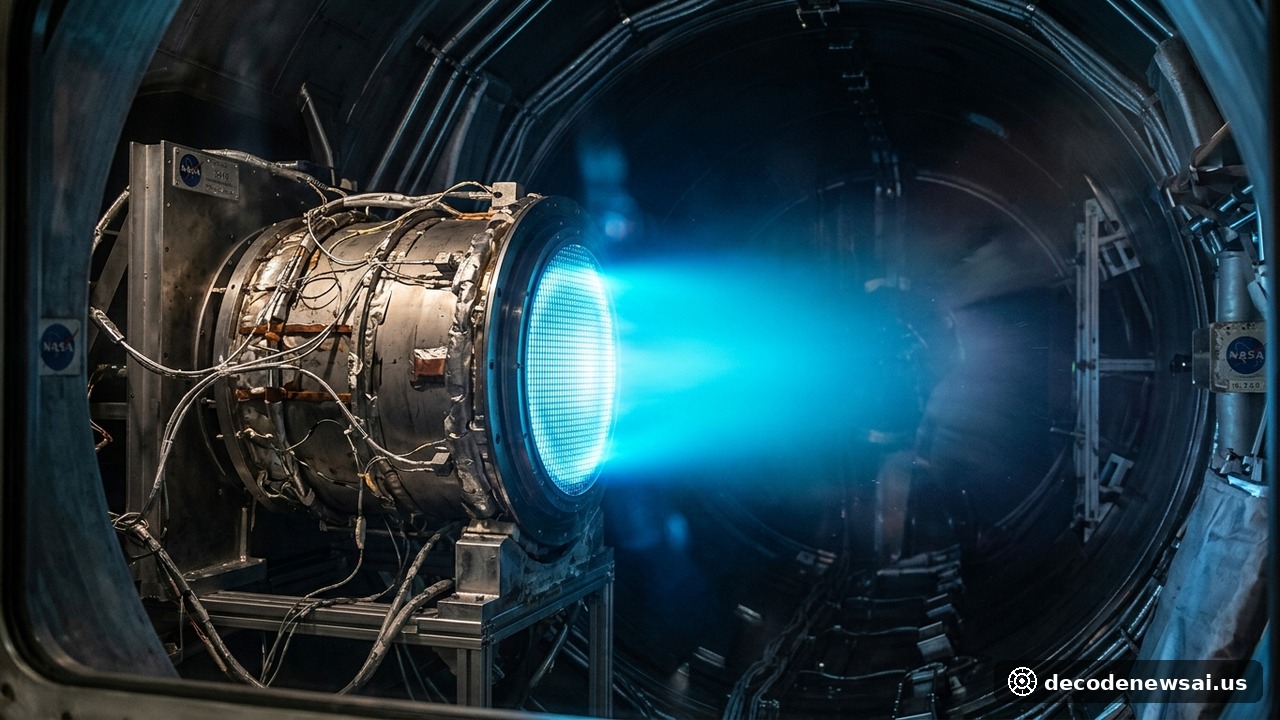
Beyond direct cash disbursements, winning teams receive access to specialized NASA test chambers. Commercial awardees can evaluate thruster prototypes within space simulation facilities at the Glenn Research Center in Cleveland, Ohio, accelerating technology readiness levels.
US-only eligibility and registration closing January 27, 2027
To strengthen domestic aerospace supply chain security, NASA established strict eligibility prerequisites for all challenge entrants. Participation is restricted to commercial enterprises organized under United States jurisdiction with principal places of business located domestically.
The challenge registration window opened officially on November 9, 2026, and will close on January 27, 2027. Interested technology organizations must submit preliminary concept documentation via the official competition portal.
Speaking at a technology demonstration conference in Washington, an associate administrator for the Space Technology Mission Directorate detailed the initiative's objectives. The administrator stated: "By establishing this incentive challenge, NASA aims to catalyze breakthroughs in electric rocket technology, ensuring our nation builds high-performance propulsion systems for deep-space missions."
Megawatt thrusters could halve Earth-Mars cargo transit times
The competition concentrates on megawatt-scale electric propulsion concepts. Scaling ion and plasma thrusters from traditional kilowatt operational ceilings into the megawatt domain represents a critical technological hurdle. Megawatt thrusters could halve transit times for uncrewed cargo tugs transiting between Earth and Mars.
American aerospace startup enterprises and propulsion contractors responded positively to the announcement, mobilizing engineering teams to draft proposal submissions. The initiative marks a significant step toward expanding human operational horizons across the solar system.
Space propulsion engineers and planetary science directors highlighted that developing megawatt-class electric propulsion architectures is essential for unlocking rapid interplanetary cargo transport. Because chemical propulsion systems impose severe mass constraints on long-duration robotic missions, high-efficiency electric thrusters enable spacecraft to transport larger scientific sensor payloads to the outer planets. Aerospace industry consortiums commended NASA for deploying commercial challenge prize structures, noting that competitive public-private prize purses encourage non-traditional defense startups to introduce agile engineering concepts. Winning technologies from the AMPERE Challenge will inform design baselines for future human logistics corridors to Mars.
Ground test data and commercial partnerships for deep-space transit
In addition, advanced spacecraft engineering faculties and robotic exploration teams noted that validating megawatt electric propulsion systems on ground test benches provides crucial design data for long-range interplanetary voyages. NASA will continue partnering with commercial industry leaders to accelerate groundbreaking aerospace propulsion technologies.
Moreover, space exploration faculties and planetary science researchers observed that developing high-power electric propulsion systems unlocks transformative transit velocity for deep-space science payloads. Collaborative commercial partnerships will continue expanding technological readiness for future robotic expeditions across the solar system. Aerospace industry contractors and academic propulsion laboratories will continue refining advanced magnetic confinement models to support high-efficiency interplanetary transit systems. NASA program executives reiterated that fostering agile commercial competition accelerates critical space exploration technologies while lowering total mission delivery expenditures for national deep-space campaigns.