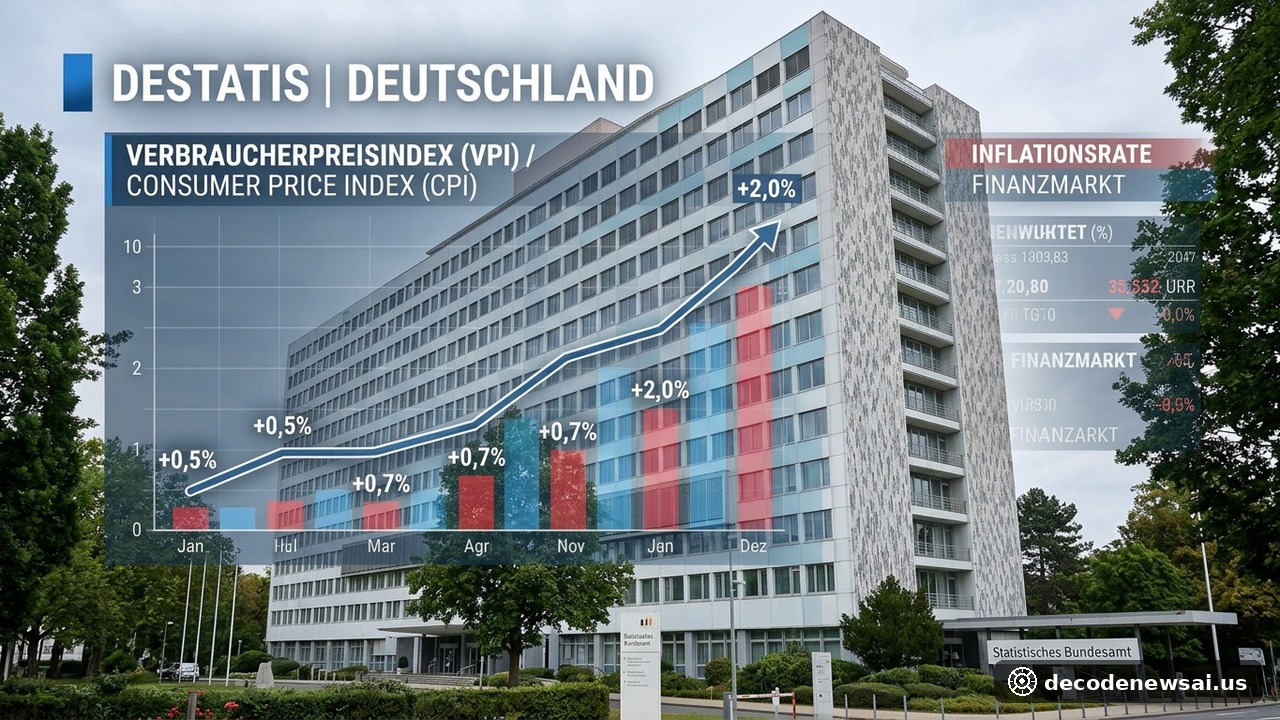
The Federal Statistical Office of Germany (Destatis) officially confirmed on November 10, 2026, that the German consumer price index rose by an annual rate of 2.0% in October, matching preliminary calculations and confirming an acceleration from the 1.6% rate recorded in September. The renewed price acceleration was primarily driven by a narrowing decline in energy prices alongside enduring inflation across labor-intensive service sectors. European Central Bank policymakers and global financial markets are closely evaluating the data for interest rate implications.
Destatis confirms energy down 5.5% and core at 2.9%
Official statistical sub-indices revealed that domestic energy product prices declined by 5.5% year-on-year in October, moderating substantially from the 7.6% annual contraction registered in the prior month.
Food product prices climbed by 2.3% on an annualized basis, sustaining persistent pressure on household living standards. Commenting on the finalized consumer price dataset during a press briefing in Wiesbaden, Destatis President Ruth Brand stated: "The downward pressure exerted by energy prices weakened noticeably in October. Concurrently, persistent price growth across consumer services continues to slow the broader return toward price stability across the national economy."
Core inflation, which strips out volatile fresh food and household energy categories, held firm at 2.9% in October, signaling persistent underlying cost pressures across non-energy commercial sectors.
Services at 3.9% drive German core inflation pressure
Service sector consumer prices advanced by 3.9% year-on-year, cementing their role as the primary structural anchor of domestic core inflation. Substantial collective bargaining wage adjustments negotiated over recent years across engineering, logistics, and municipal sectors substantially increased unit labor expenses for domestic service providers.
Hospitality venues, outpatient care facilities, corporate insurance providers, and transportation networks routinely transferred higher wage obligations into retail consumer prices. While manufacturing production indicators remained subdued, labor supply tightness across services constrained disinflationary momentum.
For the European Central Bank, German consumer price dynamics represent a crucial barometer for broader Eurozone monetary policy deliberations ahead of the upcoming December meeting. While bond markets had widely discounted a further 25-basis-point interest rate cut, the confirmed German inflation rebound has reinforced caution among monetary authorities seeking to prevent secondary inflationary spikes. Industrial groups continued to advocate for supportive economic policies to stimulate capital investment and revive domestic consumer sentiment.
Analysts warn service wages complicate ECB disinflation outlook
Macroeconomic research fellows and central bank monetary policy observers emphasized that persistent price growth across consumer services demonstrates structural wage pressures that complicate disinflationary projections. Because domestic service enterprises operate with substantial labor expenditure ratios, elevated collective bargaining settlements negotiated across logistics, hospitality, and healthcare sectors necessitate gradual price adjustments across retail channels. European financial market strategists noted that while moderating energy costs previously drove headline disinflation, underlying core consumer price trends require disciplined monetary vigilance to anchor long-term inflation expectations around the official 2.0% benchmark. Industrial confederations continued urging fiscal authorities to implement targeted infrastructure modernization policies that relieve corporate cost burdens and enhance regional competitiveness.
European economic forecasting institutes and commercial banking strategists noted that achieving durable price stability across the common currency area requires balanced fiscal and structural policies alongside independent central bank monetary stewardship. Because corporate investment decisions depend on predictable borrowing costs and stable domestic consumption patterns, maintaining anchored inflation expectations provides essential certainty for business planning. Consumer federation leaders emphasized that supporting household purchasing power through sustainable productivity gains fosters balanced and resilient economic expansion.
European central bank observers and macroeconomic policy researchers noted that harmonizing fiscal measures with prudent monetary policy ensures balanced economic recovery. Anchoring price stability supports corporate hiring decisions and consumer real purchasing power, laying a sustainable groundwork for long-term productivity gains across member economies.