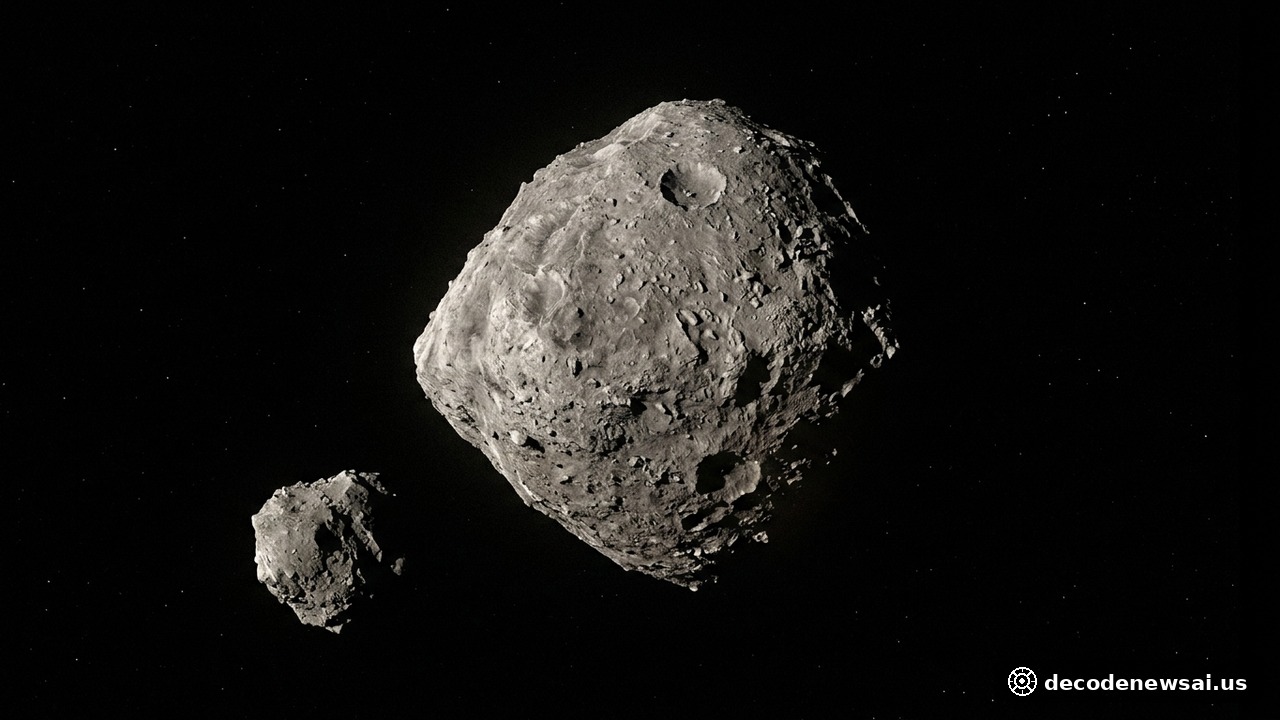
The European Space Agency's Hera planetary defense spacecraft transmitted its first high-resolution imaging surveys of the Didymos binary asteroid system on November 6. The visual telemetry reveals that the smaller moonlet Dimorphos underwent profound morphological restructuring following NASA's kinetic impact experiment two years ago. Detailed surface topographies and boulder distributions across both celestial bodies were captured with unprecedented sharpness. Planetary scientists celebrated the milestone. The imagery validates kinetic asteroid deflection mechanics.
Hera closes in on Didymos after 1128-kilogram launch
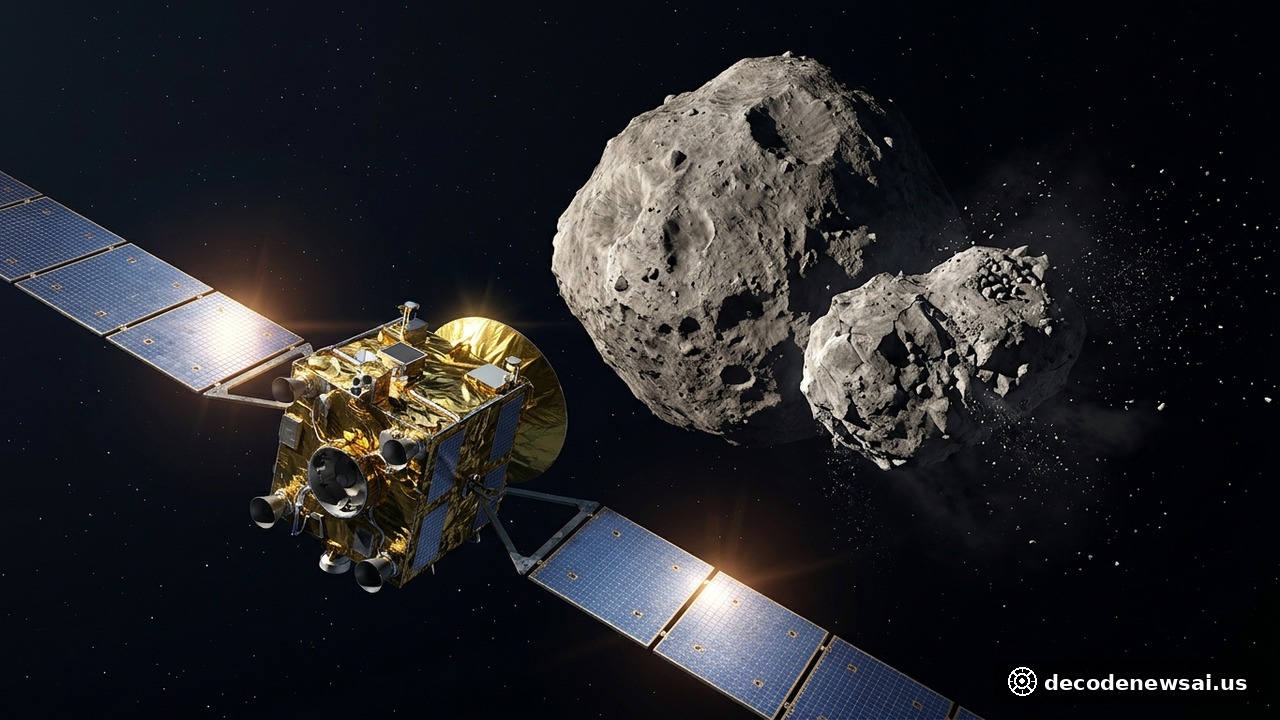
Weighing 1128 kilograms at liftoff, Hera launched in October 2024 aboard a SpaceX Falcon 9 booster from Cape Canaveral. Following a twenty-five-month interplanetary cruise, the automated probe is closing distance on the primary asteroid Didymos and its tidally locked companion Dimorphos. The scientific mission's primary objective is to inspect the impact crater and structural disruption produced when NASA's Double Asteroid Redirection Test probe struck Dimorphos at hypervelocity in September 2022. This survey represents humanity's first forensic post-impact planetary defense assessment.
Optical frames received by ground stations in Germany display extensive boulder fields, impact craters, and fracture fissures across Dimorphos. The kinetic collision deformed the global shape of the roughly 150-meter celestial body, turning a formerly oblate spheroid into an elongated debris rubble pile. Imaging instruments also documented previously unrecorded linear dust channels encircling Didymos's equatorial belt, indicating that pulverized ejecta plumes settled across both asteroids.
Michael Kueppers, Hera project scientist at the European Space Agency, stated during an operational press briefing in Darmstadt: "Hera's close-up imaging confirms that hypervelocity kinetic impacts radically remodel celestial structures. The empirical measurements gathered during this rendezvous will establish empirical formulas to safely divert Earth-crossing asteroids in the future."
Milani and Juventas CubeSats to sweep Dimorphos crater
Beyond its primary imaging suite, Hera transports two dedicated CubeSat daughter probes named Milani and Juventas. These breadbox-sized companion spacecraft will detach within weeks to perform low-altitude orbital sweeps over Dimorphos's impact crater. Juventas carries a specialized low-frequency monostatic radar designed to map internal structural porosity and subsurface void spaces within the rubble matrix.
Planetary astrophysicists observed that binary asteroid architectures preserve pristine structural records from the primordial formation of the inner solar system. By evaluating Dimorphos's revised gravitational field and rotational wobble following kinetic impact, scientists can establish whether its interior consists of a cohesive monolith or a porous gravitational rubble agglomeration. These empirical measurements are indispensable for calibrating kinetic impactor models against hazardous Earth-approaching objects. Research teams are processing continuous telemetry streams.
The coordinated investigation represents a model for international planetary defense and deep-space scientific cooperation. Mission operations teams across NASA's Deep Space Network and ESA's tracking ground stations coordinated radio telemetry handoffs without operational latency. As deep-space observation capabilities mature, space agencies are drafting roadmaps for long-duration asteroid rendezvous missions. Collaborative data frameworks reinforce international asteroid mitigation architectures.
Hera telemetry refines kinetic impact simulations
Astrophysical modeling teams at international research observatories are integrating Hera's visual telemetry into numerical impact simulations to refine dynamic crater formation theories. The physical disruption documented across Dimorphos's surface provides critical empirical calibration points for understanding how low-gravity rubble piles respond to kinetic impactors. By measuring structural ejecta distribution patterns and localized gravitational anomalies, planetary defense researchers can accurately predict momentum transfer outcomes for varying asteroid composition types. The collaborative findings will be shared with the United Nations Committee on the Peaceful Uses of Outer Space.
Planetary scientists emphasized that empirical crater morphology data collected by Hera will provide unprecedented insights into hypervelocity kinetic impacts on low-gravity porous bodies. The collaborative scientific results will inform future planetary defense protocols and advance our understanding of primitive solar system accretion dynamics. Space agencies plan to publish joint scientific monographs detailing comprehensive mission findings.
The international post-impact investigation represents an enduring cooperative partnership between the European Space Agency and NASA. Global astrophysicists are correlating spacecraft optical frames with terrestrial radar tracking data to refine orbital period displacement metrics and total momentum transfer coefficients. The resulting physical baseline will underpin future planetary defense intercept missions.