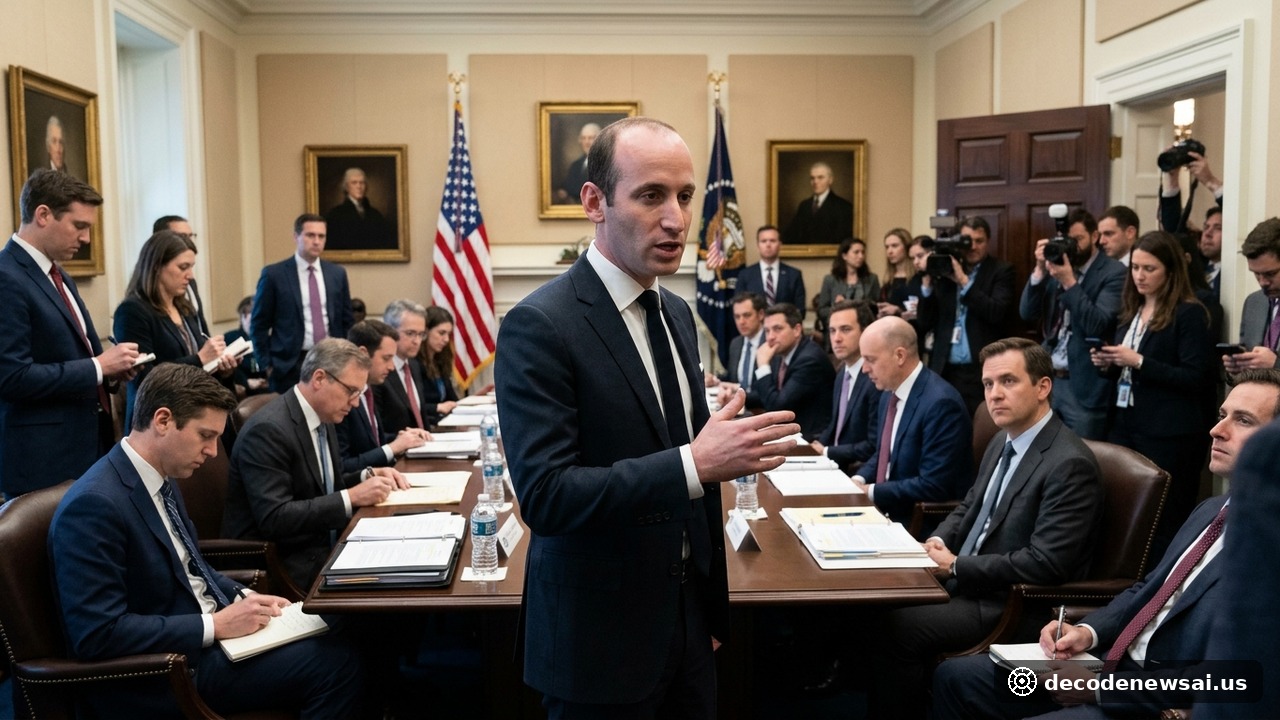
President Donald Trump formally announced on November 6, 2026, that his longtime senior ideological architect and current White House Deputy Chief of Staff for Policy, Stephen Miller, has been appointed White House Chief of Staff, succeeding Susie Wiles following her resignation in the immediate wake of sweeping Republican midterm election defeats. Serving at Trump's side across ten continuous years dating back to the nascent 2016 presidential campaign, Miller's ascension marks an uncompromising institutional shift in executive governance, demonstrating that the administration intends to confront the incoming Democratic-controlled 120th Congress not through bipartisan legislative compromise, but via aggressive executive orders, stringent border crackdowns, and confrontational institutional warfare.
What Are the Core Executive Metrics and Historical Precedents of the White House Shakeup?
- Stephen Miller's Tenure as Trump's Chief Strategist: Spanning 10 Continuous Years (Since 2016 Campaign)
- Duration of Susie Wiles' Tenure as Chief of Staff: Nearly 22 Months (Longest-Serving Under Trump)
- Primary Political Catalyst Driving Administration Pivot: Catastrophic Midterm Losses in Congress and States
- Senate Statutory Confirmation Requirement for Role: Strictly 0 (Unilateral Executive Appointment)
In detailed accounts published by The Washington Post, CBS News, and the Associated Press, outgoing Chief of Staff Susie Wiles had functioned as a calming, pragmatic institutional ballast within the West Wing, quietly managing volatile personnel, mediating between fractious Capitol Hill caucuses, and reassuring corporate stakeholders. However, the catastrophic midterm collapse on November 3—which saw Democrats decisively capture majorities in both the Senate and the House while flipping governorships in bellwethers such as Texas, Iowa, and Ohio—shattered the administration's political calculations. Populist MAGA loyalists immediately scapegoated Wiles' disciplined, low-profile style, prompting Trump to elevate his most ideological enforcer.
Miller brings deep familiarity with administrative levers, having previously served as communications director to former Alabama Senator Jeff Sessions before joining Trump's inner circle as principal speechwriter and domestic policy czar. At 41 years old, Miller is widely recognized as the uncompromising architect of Trump's border enforcement policies, historic refugee entry reductions, and aggressive legal battles over administrative authority.
How Will Miller's Appointment Radicalize Federal Administration and Border Enforcement?
Miller's stewardship will fundamentally reconstitute policy operations across the executive branch. Rather than seeking accommodation with incoming Democratic committee chairs, Miller plans to execute an aggressive administrative fortress doctrine.
Under Miller's direction, the White House will aggressively leverage the National Emergencies Act, the Insurrection Act, and targeted executive orders to redeploy military personnel to the southern border, bypassing congressional appropriations committees. Additionally, Miller is expected to purge mid-level political appointees suspected of bipartisan inclinations, staffing executive agencies with conservative attorneys pledged to defend sweeping assertions of presidential immunity and resist congressional subpoenas.
Legal analysts note that Miller's elevation signals a concerted effort to test the boundaries of executive discretion under the United States Constitution. Throughout his previous service in the administration, Miller repeatedly challenged judicial injunctions that limited the scope of presidential travel restrictions and asylum processing rules. By placing an aggressive institutional litigator in the chief of staff role, the White House prepares to fight protracted legal battles in federal district and circuit courts rather than altering policy positions to appease congressional opposition.
Furthermore, Miller's control over cabinet operations will likely accelerate administrative restructuring across independent regulatory agencies. The transition team intends to examine existing civil service protections, seeking opportunities to classify senior career bureaucrats as at-will political appointees. This centralization of operational authority within the Executive Office of the President underscores a determination to consolidate executive power during the remaining two years of Trump's presidency.
What Are the Far-Reaching Constitutional Ramifications for Divided Government in Washington?
The elevation of Stephen Miller extinguishes Wall Street and corporate expectations of a moderated second-half presidency, guaranteeing that Washington will enter an unprecedented phase of combative divided government.
With Senate Democratic Leader Chuck Schumer explicitly vowing to block all conservative judicial nominees and launch aggressive investigations into executive conduct, Miller's installation positions the White House for permanent combat. By selecting his most combative lieutenant to command the West Wing, Trump has signaled that the remainder of his term will not be governed by compromise, but by an unrelenting struggle over presidential authority, setting the stage for historic constitutional confrontations across every theater of American governance.