During a strategic transition phase centered on expanding its Neue Klasse electric vehicle offensive, BMW Group officially confirmed that lithium-iron-phosphate (LFP) battery chemistry will join its high-voltage technology portfolio. Speaking during the company's Q3 2026 earnings conference call, BMW Group Chief Executive Officer Milan Nedeljković clarified that while the Neue Klasse launch lineup is anchored by high-energy-density nickel-manganese-cobalt (NMC) cylindrical cells, the automaker will selectively introduce LFP technology for specific vehicle types and functional purposes. The executive announcement resolves prolonged industry speculation regarding battery architecture choices and establishes a differentiated dual-track chemistry strategy designed to lower entry price barriers while accelerating mass production.
CEO Nedeljković details dual NMC and LFP battery strategy
Dual Battery Chemistry Confirmed at Q3 Earnings Call
Premium electric vehicles have traditionally relied on nickel-manganese-cobalt chemistries to achieve competitive driving ranges and high sustained power delivery. BMW engineered its next-generation Gen6 battery platform around new cylindrical cells integrated within an advanced 800-volt architecture. However, as international EV markets mature and price-conscious consumers demand accessible entry points, automotive manufacturers face growing incentives to integrate cobalt-free LFP batteries into lower-tier luxury segments.
Addressing financial analysts during the quarterly presentation, Nedeljković detailed BMW's technological positioning and platform roadmap: “With Neue Klasse, we are starting with the NMC technology and the cylindric batteries, and this technology is now superior in the market. We see that our range we can offer with the iX3 and the i3 are deeply impressing also in China, and that is why we start on that level. At the same time, and you are right, the LFP technology offers a different cost structure, but also different range. So we will add the LFP technology in our vehicles, but we will be very specific in which vehicle and for which purpose. And so it will come, but it will not be a generic exchange or a generic offer in all segments.”
China-spec iX3 30L pioneers LFP in Neue Klasse lineup
The CEO's remarks confirm that BMW will not execute a blanket replacement of NMC batteries. Instead, both battery chemistries will coexist across tailored vehicle segments. NMC cathodes utilize nickel, manganese, and cobalt, providing elevated gravimetric energy density that permits substantial energy storage within a compact envelope. This characteristic remains essential for long-wheelbase executive sedans and flagship SUVs where long-distance capability and peak performance define customer expectations. Conversely, LFP chemistry eliminates expensive raw materials like cobalt and nickel, reducing production costs by approximately 20% compared to equivalent NMC packs. LFP cells also deliver superior thermal stability and extended operational cycle life. While LFP packs exhibit lower volumetric density and slower charging performance in extreme cold, their durability and cost profile make them well suited for urban commuters and entry variants.
Real-World Blueprint: China-Spec iX3 30L Demonstrates Cost and Efficiency Edge
BMW engineered the Neue Klasse platform from its inception to accommodate both cylindrical NMC packs and prismatic LFP enclosures. The production-ready proof of this modular approach is the long-wheelbase iX3 30L (chassis code NA6), developed exclusively for the Chinese automotive market. The model serves as the pioneer application of LFP chemistry within the Neue Klasse portfolio, positioned beneath the higher-grade 40L and 50L xDrive variants that maintain NMC cylindrical cells.
iX3 30L delivers 630 km range and 22-minute charging
As the baseline offering, the iX3 30L is equipped with a 77-kWh battery pack that delivers a certified driving range of 630 kilometers (391 miles) on China's CLTC testing cycle. Commercial pricing starts at RMB 269,900 (approximately $40,000 or €34,300), offering a substantially reduced barrier to entry for prospective premium EV buyers.
Real-world operational telemetry validates the engineering efficacy of BMW's LFP integration. On high-power DC fast chargers, the iX3 30L replenishes its battery state of charge from 10% to 80% in 22 minutes—only one minute longer than the 21 minutes required by the dual-motor 40L and 50L xDrive models. For alternating current charging, a full 0 to 100% session takes less than 11 hours, outperforming the recharge duration of higher-tier NMC variants. Through refined thermal management and optimized vehicle aerodynamics, the iX3 30L registers an energy consumption rate of 13 kWh/100 km, recording the highest efficiency within the model line. The engineering benchmark confirms that robust platform packaging enables LFP chemistry to satisfy consumer expectations without compromising charging speed or reliability.
Gen6 Battery Industrialization Accelerates Across Global Plants
Gen6 battery production expands across global plants
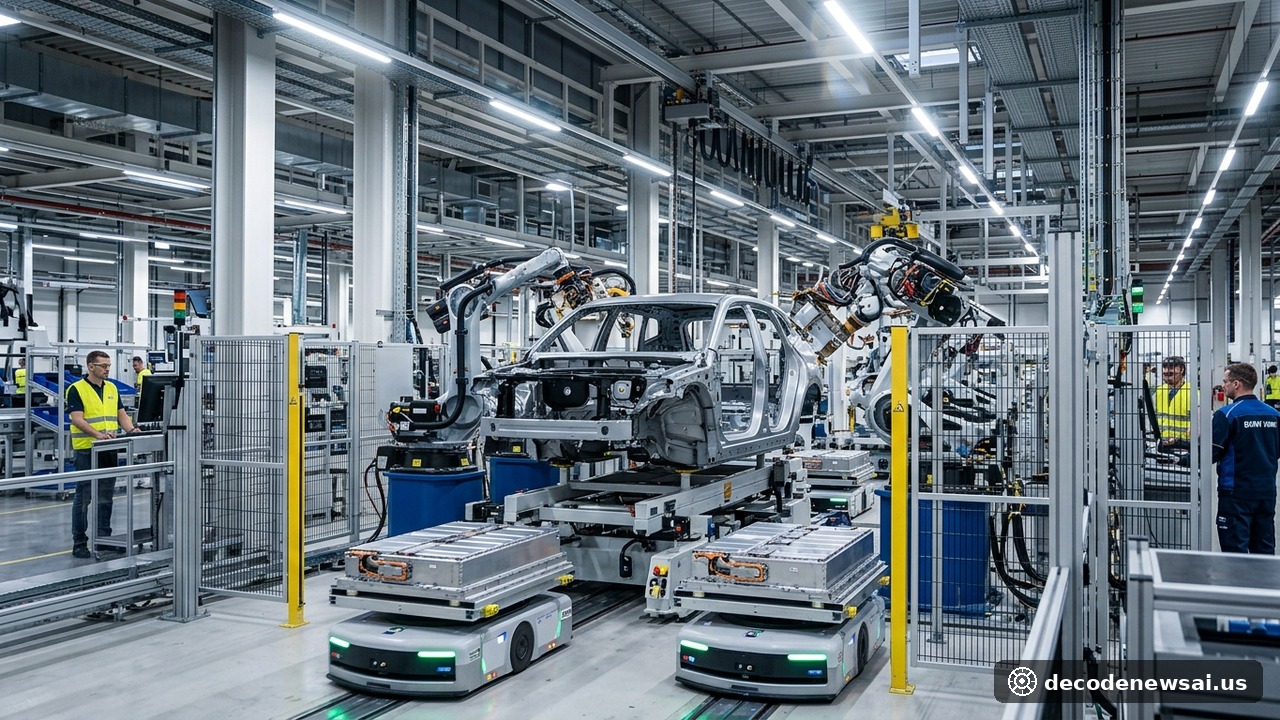
The technological foundation of the Neue Klasse architecture is BMW's sixth-generation eDrive and battery ecosystem. Gen6 high-voltage packs incorporate cylindrical cells within an 800-volt electrical backbone and utilize a cell-to-pack (CTP) structural methodology that eliminates intermediate battery modules. Compared to fifth-generation systems, Gen6 delivers more than 20% higher energy density while improving charging speeds and overall driving range by up to 30%. Supported by more than 500 engineering patents, BMW's Gen6 battery system earned the “Global New Energy Vehicle Innovative Technology” award at the 2026 World New Energy Vehicle Congress (WNEVC), marking BMW as the sole international automaker recognized at the summit.
To support the industrial rollout of Neue Klasse vehicles, BMW is executing a “local-for-local” battery manufacturing strategy. Following initial production launches at Debrecen in Hungary and Irlbach-Straßkirchen in Germany, the company's battery center in Shenyang, China, commenced series production of Gen6 packs to supply locally manufactured long-wheelbase models. Assembly facilities in Woodruff, South Carolina, and San Luis Potosí, Mexico, are slated to begin series manufacturing over the coming months. By incorporating cost-effective LFP batteries alongside high-performance NMC cells, BMW establishes a scalable industrial framework to accelerate the global transition toward sustainable electromobility.