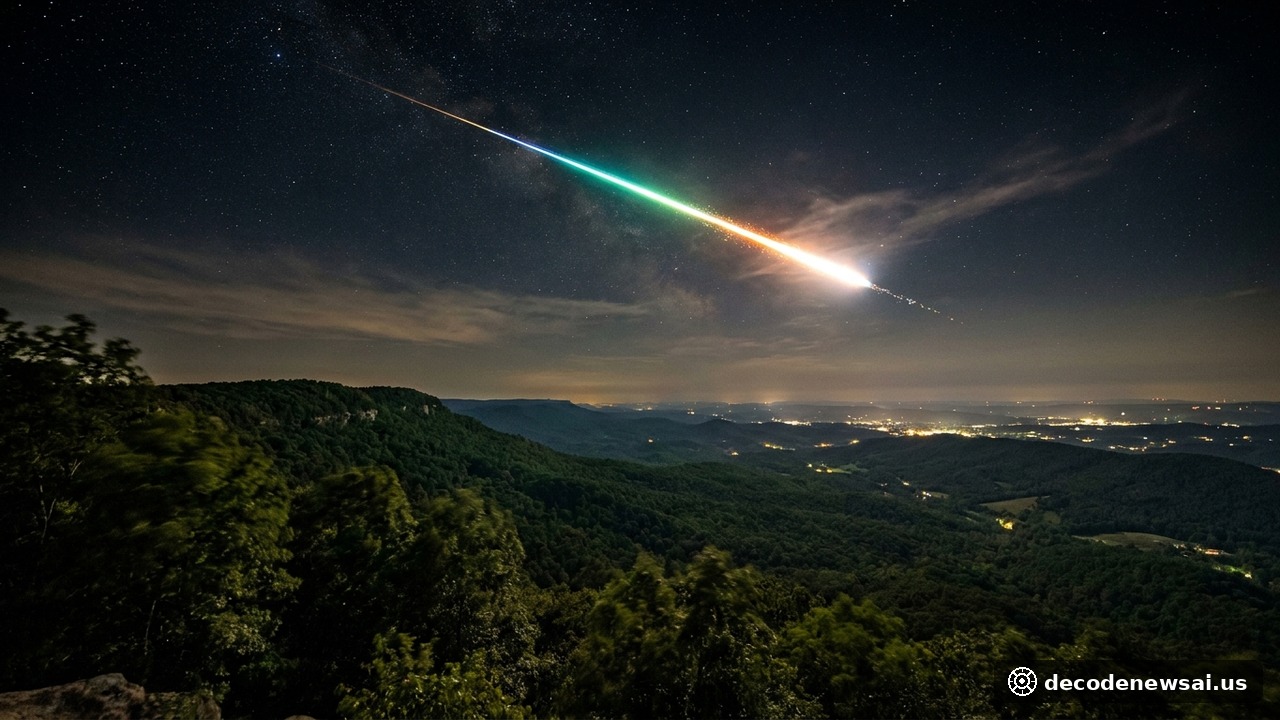
CHATTANOOGA, Tenn. — NASA's meteor observation network confirmed that a brilliant fireball seen across three southeastern states was a high-velocity asteroid fragment that disintegrated over Tennessee. The space agency verified the trajectory using ground cameras. The object entered Earth's atmosphere traveling at approximately 47,000 miles per hour before vaporizing high above the ground. Multi-Station Camera Network Tracks Trajectory The celestial event occurred at 7:45 p.m. Eastern time on Thursday, November 5, 2026. The flash drew immediate attention. Skywatchers across eastern Tennessee, western North Carolina, and northern Georgia reported seeing a bright greenish streak flash across the evening sky.
Two-inch fragment releases extreme atmospheric energy
The regional nodes of the NASA All-Sky Fireball Network tracked the incoming meteor through automated optical sensors. Four cameras logged the event. The camera recordings enabled researchers to compute orbital geometry and track atmospheric descent. Photometric measurements established that the fireball reached an apparent magnitude of -6.1, briefly outshining the brightest celestial bodies in the evening quadrant.
Calculations showed that the meteor was first detected at an altitude of 53 miles above Robbinsville, North Carolina. Robbinsville lies in remote terrain. Traveling on a trajectory slightly south of west, the object traversed state lines in less than ten seconds before breaking apart. Minute Fragment Releases Extreme Atmospheric Energy NASA's Meteoroid Environment Office subsequently released baseline physical metrics for the object. The projectile was remarkably compact. The analysis confirmed the fragment measured roughly two inches in diameter and weighed approximately six ounces.
Despite its modest mass, the object possessed tremendous kinetic energy upon striking the upper atmosphere. Atmospheric friction triggered intense heating. The fragment sustained an atmospheric velocity of 47,000 miles per hour, or roughly 13 miles per second, before experiencing catastrophic thermal and aerodynamic disruption 25 miles above East Ridge, Tennessee. East Ridge borders southern Chattanooga.
Fireball ruled out as Taurid shower member
The disintegration occurred more than 40 kilometers above populated valleys. Ground safety was never compromised. NASA optical sensors observed no surviving fragments, indicating the body was entirely ablated into microscopic atmospheric dust without producing meteorites on the surface. Disconnection from Taurid Shower and Ancient Solar Lineage Because the event coincided with early November, local observers initially questioned whether the display was linked to the annual Taurid meteor shower. The Taurids regularly produce fireballs. NASA astronomers analyzed the orbital trajectory and ruled out any link to that stream.
The orbital path failed to match the characteristic trajectory of Comet Encke, the parent source of Taurid debris. The trajectory pointed elsewhere. In an official briefing, NASA confirmed: "The fireball was a small fragment of an asteroid burning up in Earth's atmosphere, and it broke apart almost directly over the Chattanooga area."
Scientists determined the object was an independent asteroidal fragment dating back roughly 4.6 billion years to the formation of the early solar system. Planetary remnants hold ancient data. Tracking ancient asteroidal debris provides crucial empirical observations on interplanetary mass distribution and aerodynamic ablation mechanisms in the upper atmosphere. Advanced Ground Sensor Architecture and Planetary Defense Insights The detection highlights the continuous surveillance capabilities provided by automated ground-based sky arrays. Regional camera networks operate continuously. The NASA All-Sky Fireball Network uses specialized wide-angle video cameras deployed across research facilities, observatories, and universities in the southeastern quadrant to achieve overlapping stereoscopic observation.
Ground cameras track 47,000 miles per hour meteor
When a high-velocity meteor penetrates the upper atmosphere, multi-station triangulation instantly tracks the luminous trajectory and models deceleration parameters. Velocity curves reveal density. By comparing deceleration curves with known aerodynamic entry physics, researchers determine physical integrity and internal mineral structure. In this instance, the rapid complete fragmentation confirmed a loose, porous stony composition characteristic of primitive solar system remnants. Planetary scientists emphasize that systematic detection of sub-meter projectiles provides an essential baseline for assessing continuous mass influx into Earth's environment.