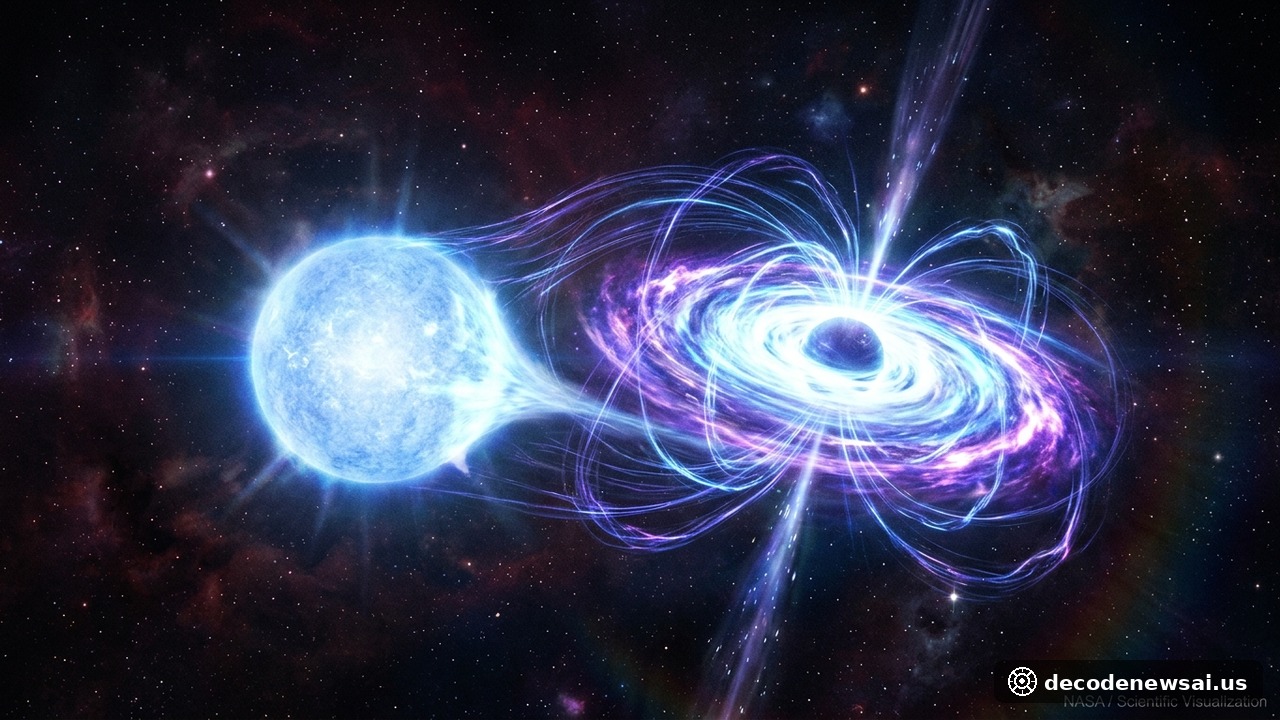
WASHINGTON - Astronomers utilizing NASA's Chandra X-ray Observatory announced a major astrophysics breakthrough on Monday, November 9, resolving the long-standing mystery surrounding the periodic, violent eruptions of giant unstable star AT 2016blu. Detailed high-energy spectroscopic observations revealed the presence of a previously undetected stellar-mass black hole or neutron star orbiting the massive star, triggering intense X-ray outbursts every 113 days through gravitational tidal disruption.
Chandra detects compact companion stripping massive star gas
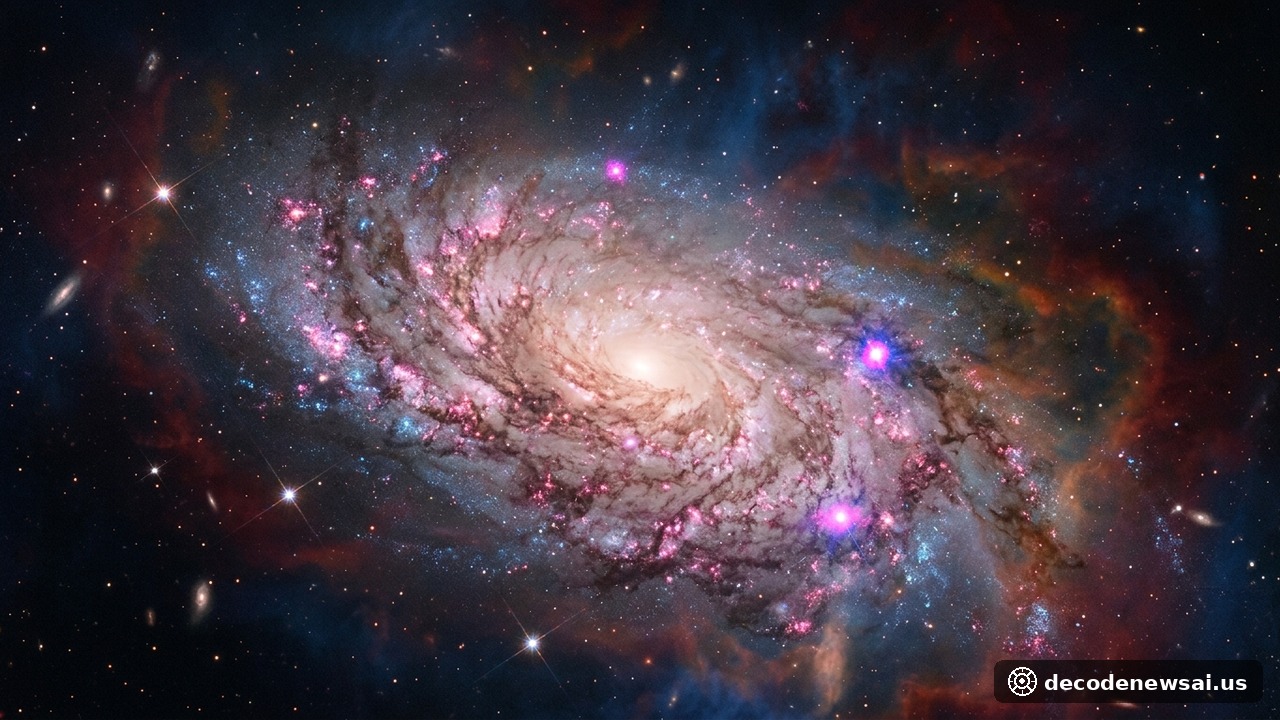
The massive star is located roughly 30 million light-years from Earth within the outer spiral arms of galaxy NGC 4559, possessing a stellar mass approximately 33 times that of the Sun. For more than fifteen years, international astronomical teams tracked the celestial object using ground-based optical observatories, recording recurring optical brightening and dimming cycles without establishing the underlying mechanical trigger. Optical instruments alone could not penetrate the dense circumstellar envelope to detect the energetic primary driver.
Researchers from the Harvard-Smithsonian Center for Astrophysics scheduled high-precision X-ray grating observations with Chandra during calculated periastron passages. The data demonstrated that during close orbital approaches, the intense gravitational gradient of the compact companion strips superheated atmospheric hydrogen and helium gas from the giant star. As the transferred stellar matter accelerates toward the event horizon, it experiences extreme compressional heating, emitting energetic X-ray radiation.
The Lead Investigator of the Chandra research team stated during an official NASA press briefing: "Chandra's exceptional spatial and spectral resolution captured the definitive signatures of matter transfer in this extreme binary. The predictable 113-day orbital clock transforms this system into an ideal natural laboratory for studying relativistic tidal accretion." Astrophysics researchers praised the conclusive findings.
Paper confirms first massive eruptive star with black hole
The peer-reviewed paper was formally published on Monday in The Astrophysical Journal. The milestone marks both the first X-ray detection of this rare category of luminous erupting variables and the first confirmation of a massive eruptive star physically paired with a stellar-mass black hole companion. The empirical observations provide essential constraints for computational models of gravitational wave progenitor systems and binary stellar evolution.
International space science organizations noted that multi-wavelength monitoring campaigns will continue utilizing orbital observatories to evaluate accretion disk precession and relativistic jet physics. Demonstrating the continued scientific productivity of flagship space astrophysics platforms expands humanity's fundamental understanding of high-energy cosmic evolution across the universe.
Astrophysical theorists emphasized that empirical confirmation of a massive star paired with a compact black hole companion provides vital observational constraints for stellar mass transfer models. The systematic 113-day outburst cycle allows orbital space telescopes to coordinate precision observations across gamma-ray, optical, and radio wavelengths during maximum accretion phases. Data collected by Chandra demonstrates the enduring observational capabilities of NASA's Great Observatories program, illustrating how long-duration space science missions continue delivering groundbreaking astronomical insights. International research collaborations between the Harvard-Smithsonian Center for Astrophysics and European observatories highlight the global cooperation driving modern space exploration. Investigating high-energy plasma dynamics around compact stellar objects directly advances fundamental understanding regarding relativistic physics and the ultimate fate of massive stars across the cosmos.
Researchers affirm value of space telescope observations
Observational astrophysics researchers noted that high-resolution space telescope missions generate irreplaceable empirical datasets for multi-messenger astronomy. Theoretical physicists affirmed that detailed orbital accretion measurements provide critical benchmarks for testing gravitational wave emission models. International astronomical consortia underscored that sustained investments in flagship space observatories continue to expand foundational cosmic knowledge across global research institutions. Astrophysical research directors affirmed that multi-wavelength space telescope investigations generate transformative empirical insights into extreme stellar physics. Continuing long-term observational campaigns expands scientific understanding of relativistic mass transfer mechanisms across distant galactic environments. Astrophysical survey teams highlighted that long-term space telescope observations provide invaluable empirical constraints on the lifecycle of massive star systems.