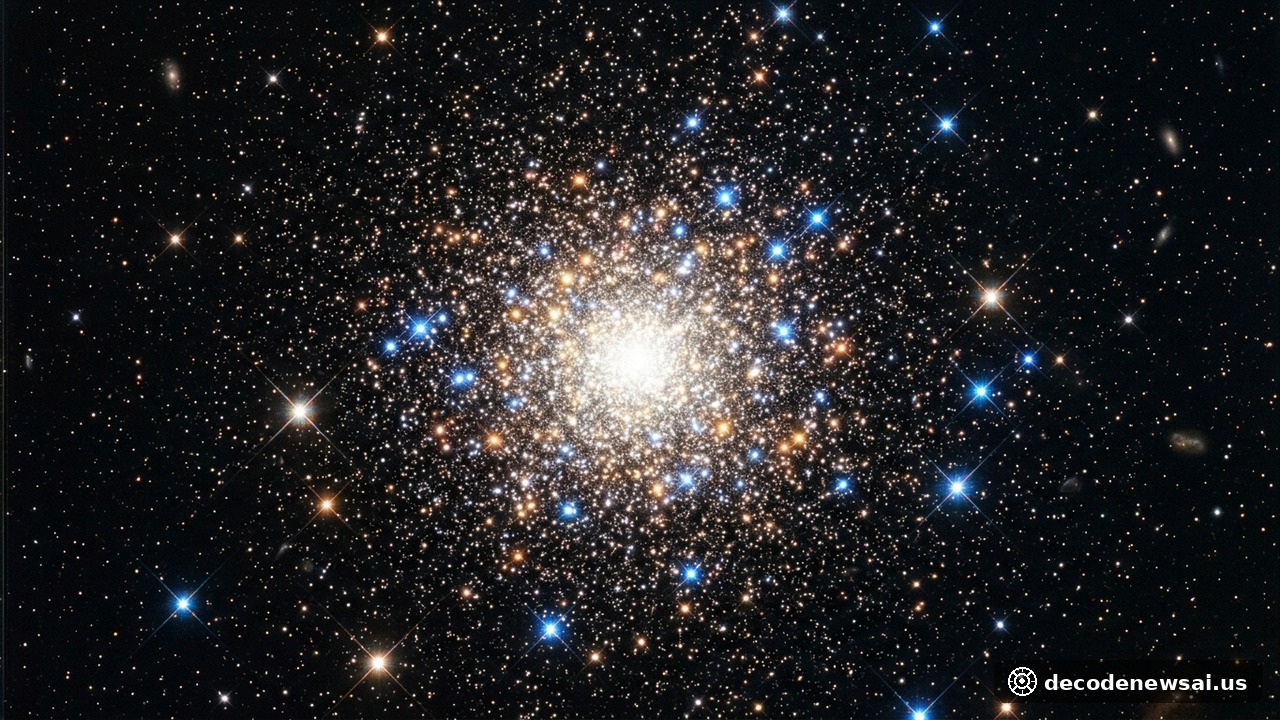
An international team of astrophysicists operating the NASA/ESA Hubble Space Telescope published comprehensive spectroscopic and photometric observations of globular cluster Messier 30 (NGC 7099) on November 9, 2026. Published in The Astrophysical Journal and detailed via Sci.News, the high-resolution survey conducted with Hubble's Advanced Camera for Surveys examines the dense central stellar core of the ancient cluster. The findings demonstrate that core gravitational collapse directly drives the formation of anomalous blue straggler stars, preserving vital kinematic relics of the early accretion history of the Milky Way galaxy.
Messier 30 core collapse and 134 blue stragglers
Located approximately 27,000 light-years from Earth in the constellation Capricornus, Messier 30 is estimated to be over 12.5 billion years old, making it one of the most primitive surviving stellar structures in the galactic halo.
The cluster represents an archetype of core collapse, an advanced dynamical state where stellar interactions siphon kinetic energy from the center, causing the core to contract into an ultra-dense central cusp. In the central parsec of Messier 30, millions of stars crowd into a volume thousands of times denser than the solar neighborhood, dramatically escalating the probability of physical collisions.
The research team cataloged 134 prominent blue straggler stars residing within the cluster's core. Blue stragglers appear paradoxically younger and more massive than the ancient stellar population surrounding them, burning hotter and brighter than standard main-sequence turnoff thresholds allow.
Two blue straggler pathways and Gaia-Enceladus capture
Hubble's multi-wavelength ultraviolet imagery confirmed two distinct evolutionary pathways for these stellar anomalies. While a fraction formed via gradual mass transfer within tight binary orbits, a substantial subpopulation originated through direct kinetic collisions between unrelated stars in the crowded gravitational core.
Kinematic orbital modeling revealed that Messier 30 travels along a highly retrograde, eccentric trajectory that deviates sharply from standard galactic disk rotation. This orbital orientation supports the hypothesis that Messier 30 was not born natively within the Milky Way, but was captured approximately 10 billion years ago during the tidal disruption of the Gaia-Enceladus progenitor dwarf galaxy.
In an official research briefing released by the European Southern Observatory, lead author Dr. Francesco Ferraro of the University of Bologna underlined the cosmological significance of the observations. Dr. Ferraro stated: "Messier 30 provides an exquisite stellar laboratory demonstrating how gravitational core collapse and stellar collisions preserve records of ancient galactic accretion."
Hubble constraints for N-body simulations of galactic halo
The Hubble survey provides astronomers with crucial empirical constraints for calibrating N-body gravitational simulations and understanding how galactic cannibalism shaped the halo of the modern Milky Way.
Observational astronomers and galactic dynamical modelers emphasized that core-collapsed globular clusters serve as pristine archaeological laboratories for reconstructing the formation history of the galactic halo. The dense concentration of ancient stars within Messier 30's central parsec accelerates physical stellar collisions and tidal mass transfer, producing unique populations of rejuvenation blue stragglers that challenge standard stellar evolution paradigms. High-precision space telescope observations allow astrophysicists to disentangle distinct kinematic formation channels and calibrate sophisticated gravitational N-body simulations with observational accuracy. The retrograde orbital velocity of Messier 30 provides compelling physical evidence corroborating that the Milky Way expanded hierarchically through the gravitational disruption and accretion of ancient progenitor dwarf galaxies. Astronomers anticipate that upcoming wide-field orbital observatories will leverage Hubble's foundational observations to catalog ancient globular clusters across neighboring galactic systems.
Astrophysical theorists and galactic observational researchers noted that high-resolution space telescope imaging provides unprecedented detail into complex stellar interactions. Analyzing core-collapsed stellar clusters uncovers empirical evidence that refines fundamental theories of stellar evolution and galactic assembly across cosmic timeframes. Future orbital observatories will expand upon Hubble's spectroscopic legacy to examine primitive globular clusters across the distant universe.